Showing posts with label Gaia wine. Show all posts

Thursday, January 6, 2022

Give me Five! 5 New Grapes for 2022


Let’s get 2022 off to an exciting start with five new delightful wine grapes to try.  When I say new, I mean new to Americans---all of these varieties have been growing for centuries in Europe.   In fact, wine lovers who have traveled to Croatia’s Dalmatian Coast, the Greek Island of Santorini, northwest Spain, or Sicily may have sampled them, but essentially these varietals remain unknown to Americans.  The good news is that all of them are imported----and because of their obscurity, they are terrific buys (many at rock-bottom pricing considering their quality).

                                 Korcula island is home to both the Posip grape & Marco Polo

Posip, an intensely aromatic and flavor-chocked white wine grape, is Croatia’s best kept secret.   Grown exclusively on the Dalmatian coastline, this variety is indigenous to the island of Korcula (better known as the island where Marco Polo was born).  Posip is the result of two obscure grape varieties crossing in a Korcula vineyard.  This sleeper wine delivers tastes of figs, citrus, apricots and almonds, along with decent acidity.  I recently bought online a case of my favorite producer, Black Horse.  The name of the wine is Mega Vieta and the 2020 vintage is superb. ($20 per bottle)

                                         Santorini offers mind-boggling views & stunning wines

The second of the five new varietals is also from an island, but this one's located in Greece.  Santorini is certainly one of the most dramatic gems of the Mediterranean.  The Assyrtiko grape, like Posip, is native to the island on which it is grown.  Assyrtiko thrives in Santorini's  arid climate in inhospitable volcanic ash soil.  This wine is reminiscent of a Sauv Blanc with a lemon-lime profile with compelling mineral nuances.  Like Posip, Santorini's native variety brings the necessary acid to carry the wine's structure.  Look no further than Gaia or Sigalas for the best producer.  Plan on $25-30 bucks per bottle.

Keeping with the theme of islands, let's now move to the Mediterranean's largest:  Sicily.  There are two unknown grapes here that need to jump-start your 2022.  The first is a varietal called Grillo.  On a recent Wine-Knows' trip to Sicily, I couldn't get enough of this white wine which offers apple, citrus, and almond nuances.   I particularly enjoyed Valle dell'Acate's Zagra at <$20.

                         This Frapatto is named after haute couture designer, Carolina Marengo 

The second Sicilian varietal you need to try is Frapatto, a red wine grape.   Frapatto is, however, a light weight red so it works perfectly with fish, seafood and poultry prepared in a simple way without complicated sauces.    Think strawberries and cherries laced with a floral component.   One of my faves is Feudo del Pisciotto's Carolina Marengo Kisa.  It's available for about $30 buck.   

          Pazo Senorans is always a must-visit winery on Wine-Knows' Galicia tours (next trip 2024)

The last of the five new wine grapes is from the mainland of Spain, an area called Galicia in the far northwest corner of the country.   Albarino, the name of the grape and the wine, comes from the province of Galicia.  This grape is grown in Spain as well as Portugal.  In Galicia it reaches its pinnacle creating wines with a beautiful melange of stone fruit and citrus flavors.   I highly recommend Pazo Senorans who produces several Albarinos that range from $20-30.


Have an adventurous 2022 and try some of these unknown wines!


Thursday, December 30, 2021

Sensational Santorini

                                         Santorini is like no other spot in the Mediterranean

Winter has now officially descended upon us.  To bring some brightness to these dark December days I am writing a three-part series on my favorite Mediterranean islands.  Today we're traveling to the last island, Santorini.  This Greek jet-setting, jaw-dropping, pleasure-bomb of an island is unparalleled for sheer beauty.  However, Santorini also makes some stunning wines, offers archaeological ruins, and has some mind-blowing walks. 

          Grapes are grown close to the ground in baskets to protect against winds & conserve water 

Santorini has one of the most unique terroirs in the Mediterranean.   The entire island is part of a large volcano system---most of it underwater.  In fact, Santorini is part of a cluster of several surrounding islands that were formed millenniums ago by catastrophic eruptions.  This ring of islands is actually the tops of the underwater volcanoes that have collapsed into the sea, leaving only their tips exposed.     

                                 Gaia hosted WineKnows in their captivating "tasting room" 

Santorini's volcanic soil makes for some terrific wines that ooze minerality.   Summers are hot and there is very little water on the island, so the vines must send their roots deep into the soil to seek moisture.  On this journey penetrating deep into a soil rich in magnesium, iron, calcium and selenium, roots bring back to the plant fascinating flavors for their grapes.  There are several excellent wineries on the island.  My favorite is Gaia (who is even experimenting with aging wines on the ocean floor).  

                           The walk from Fira to Oia is one of the most spectacular on earth

But, there is so much more to Santorini than its wine.  The most compelling thing about the island is its mesmerizing natural beauty.  For walkers, there is no better way to appreciate its magnificence than the walk from Fira (the main town) to Oia.  This hike, which parallels the sea, is arduous and take >2 hours, but its worth every moment (and you can take the bus back to Fira).  Another don't miss is the archaeological ruin at Akrotiri, Santorini's version of Pompeii.  Destroyed by volcanic ash in 1,700 BC, this ancient town is worth a visit.

                    Mextaxy Mas, only a 10 minute cab ride from the main town, feels a world away

For me, another irresistible reason to visit Santorini is to dine at Metaxy Mas.  Located in the center of the island in a small rural village away from the hoards of tourists, this restaurant shouldn't be missed.   Metaxy Mas has it all:  fabulous food, a sexy setting (be certain to reserve for the terrace), and an authentically Greek feel.  The name translates to "between us," and between you and me, Metaxy Mas is a winner.

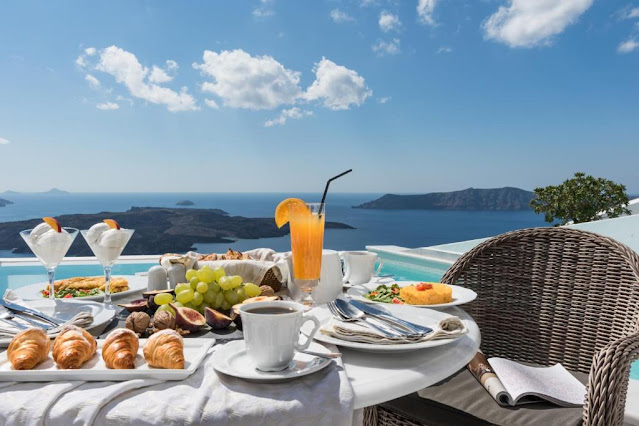
Breakfast at Anteliz is a special event.

Santorini is replete with a number of hotels and apartments in every price category, however, look no further than Anteliz Suites for a place to stay.  Located in the island's capital town of Fira (but away from the crowds), this spot delivers on every level....from breathtaking panoramic views and superb service (family owned, there is nothing these people can't do can't do for you), to wonderfully-outfitted rooms.  If you can spring for the Anteliz Master Suite, you'll enjoy 1,200 square feet of enchantment including a huge private terrace, however, even their regular hotel rooms are noteworthy.

Cheers to a healthy, sunny and travel-filled 2022!


Friday, January 5, 2018

Rock-Star Minerality

                                          Minerality can add a compelling nuance to wine

“Lick it” the winemaker instructed.  “Lick the rock” he demanded of our bulging eyeballs’ group of Wine-Knows.   We were in a vineyard filled with rocks at the base of the Andes mountains in Argentina and we all giggled…and then complied.  Suddenly it became very quiet as everyone was seemingly trying to process the wonder and the words to explain what they had just tasted.

“Salt” one Wine-Know volunteered.  Another offered a caveat:  “What I taste is the smell of wet earth.”  This prompted another tour participant to chime in that she tasted the “smell of river pebbles.”  A few offered comments about the texture of what they tasted describing it as “pasty” or “thick.”  All appeared to be surprised about what they had just experienced.

Minerality can be a difficult concept, especially for new wine drinkers.  First, most novices are drawn to fruity wines.  Second, the majority of wines are fruit-forward so that subtle nuances of minerality take a back seat.  Last, there isn’t a lot of common language to discuss these mineral-like smells and tastes.  This makes minerality even tricky for some veterans to wrap their arms around.

Where minerality in wine comes from is still unknown.  We don’t really know how it happens although there are many theories.  What is known is that there are certain chemicals that have been isolated in wine that have been shown to promote smells and tastes of minerals.  With flavors of strawberries in a Pinot Noir, or green apples in a Chardonnay we understand that there are not actually berries or apples in these wines.  Thus, it makes sense that certain compounds would give off non-fruit smells and instead offer hints of minerals.

The best recommendation I have for trying to understand minerality in your glass is Assyrtiko wine from the island of Santorini, Greece.  This varietal is all about minerals and there's little competing fruit (you can actually taste the minerality of the island's famous volcano).  Suggested best producers of this enticing white wine include Gaia, Sigalas and Boutari.


Rock-out in 2018!