Showing posts with label Hungary wine. Show all posts

Friday, April 27, 2018

Austrian Reds


Burgenland is a hidden gem wine district

While 70% of Austria’s wine is white, there’s a secret pocket of reds located on its eastern border with Hungary.   Known as Burgenland, this Austrian wine district was part of Hungary until 1921.  (Amazingly, even today to get expediently from some parts of Burgenland to another area of this wine region, one has to cross the border into Hungary and then re-enter Austria from another location.)

Burgenland, located just one hour south of Vienna, is very popular with Viennese seeking a weekend getaway.  The wine district is rural with small wine-centric villages dotting its bucolic rolling hills.  Adding to the relaxing landscape is a series of small lakes which offer opportunities for weekend tourists, but also provide an enormous effect on the terroir for wine.

            Burgenland's lakes help moderate its climate

Full bodied red wines are the hallmark of Burgenland.  Hot summers ensure ripe fruit with complex flavors.  Humidity from the lakes offer cooling during the summer nights so that vines can rest.  Limestone, mixed with sand and clay add to the terroir and provide good grape-growing soil.   

Burgenland’s grape varieties offer an interesting experience for Americans in that the region offers varietals not grown in the US.  Blaufränkisch is the flagship grape.  It makes complex, berry-driven wines.  Zweigelt is the widely planted grape in the district.  This varietal creates lighter-bodied red wines with a major cherry profile.

Best producers of Burgenland?  Look no further than Feiler-Artinger and Weingut Gunter & Regina Triebaumer.   Wine-Knows will be visiting both wineries on its sold-out tour this autumn.


Friday, January 12, 2018

Wine from a New Old World

           Uber modern winery in Hungary--Wine Knows will stay on this dramatic estate 

Visiting Hungary’s wine regions offers a tasting trip around a new Old World. 
State-of-the-art wineries right out of Napa Valley and winemakers armed with
viticultural degrees from top international universities are juxtaposed with ancient
cellars and winemaking traditions that remind us of this country’s remarkably rich
wine heritage.

Like most countries in Europe, Hungary’s history with wine grapes dates back to
the Romans.  In the 11th century Hungary was a key player in wine production. 
During the Ottoman occupation of the 16th and 17th century, however, this all
changed as alcohol was forbidden due to tenants of the Muslim religion. Tokaj was
the exception as its wine production thrived thanks to it being an independent
state of Transylvania.

In the 1700’s Hungary once again  became a formidable force in the wine-making world.  The course of wine history changed for all of Europe in the late 1800’s when a bug called Phylloxera destroyed nearly every vineyard on the continent.  (Interestingly, it was, a Hungarian who played a major role in developing a Phylloxera-
resistant root stock that got the wine industry moving again).  Post World War II
Communism was the final nail in the coffin.  A once flourishing wine industry was
relegated to producing bulk wine for the masses.

Today, Hungary is the 17th largest producer of wine in the world.  To put its
regional size in perspective, it is larger in wine production than neighboring
Austria, but smaller than its neighbors Bulgaria and Romania.  Currently that are
>150,000 acres under vine spread across the Hungary’s 22 wine regions and sub-
regions.

Hungary joined the EU in 2004.  Financing from the EU has catapulted Hungary
from the downward spiral of Communism into a new world of opportunity. 
Hungary has stepped up to the plate, especially the Tokaj region.  One of the few
in the wine world to reinvent itself, Tokaj seized the opportunity to turn from sweet
wines to dry.  Old World Tokaj is a Cinderella story.   Many of Tokaj’s wines are
now stunning dry whites.  They are using the same Old World grape (Furmint) but
vinifying them bone dry.  Furmint is becoming the new darling varietal of many
Sommeliers.

But, Hungary is not a one trick pony.  The country is making some gorgeous red
wines.  In fact, one of Hungary’s reds beat out one of the most famous Old World
chateau in all of Bordeaux in a blind tasting. 

If you’re looking for something new to try in the New Year, but appreciate well-
crafted Old World wines, put Hungary on your 2018 list.  The country is emerging
as an exciting player on the international wine scene.  Highly recommend one of
the following producers that this autumn Wine-Knows will be visiting (sorry but this tour is sold out with a waiting list).

          Dry White (alpha order):
                 Hetzolo
                 Kikelet
                 Svent Tamás
    
          Red (alpha order):
             Attila Gere
             Bock


Friday, October 27, 2017

How Rotten Luck Created an Amazing Wine

                  Botrytis Cinera causes chemical changes which enhance aromas & flavors

The year was 1847.  California was not even a state yet and the Mexican-American War was full throttle.  Across the Atlantic in France, however, the Bordeaux region was enduring its own battle against a horrible fungus that had destroyed their production of Sauternes wines.  Vineyards lay in decay, a huge disaster of rotting fruit covered with an invading army of organisms which had attacked the grapes’ skins and caused them to dry and shrivel like raisins.  Many chateaux didn’t even bother to pick their fruit.  

                  Chateau Yquem's location near the convergence of 2 rivers is perfect for Botrytis

Chateau Yquem, one of the top wineries of the time and the most prestigious producer of Sauternes today, decided to pick some of its fruit, however, the quality was so bad that Yquem decided not to release the wine for sale.  Their entire 1847 vintage remained in Yquem’s cellar until 1859 when the brother of Russia’s Czar visited the esteemed chateau.   This visit changed the course of history for Bordeaux’s sweet wine industry.

The Russian monarchy and aristocracy of the 1800’s had long been great admirers of Hungary’s sweet wines, Tokaj (Tokay).   These very special sweet wines were like no other sweet wines.   While Hungary had been producing these unique wines for 200 years, their production was limited.  The wines were not produced every year as their production was entirely weather dependent.  As the demand of Russia’s royalty was high, these special sweet wines commanded regal prices.  When the Russian Grand Duke visited Bordeaux in 1859 he heard the story of the grey fungus invasion of 1847.  A light bulb went off in his head.

                                     Liquid gold from Bordeaux's Chateau Yquem

The Grand Duke knew that the limited Hungarian sweet wine of Tokaj was made only during the years of the Tokaj’s grey fungus.  He asked to try Chateau Yquem’s 1847.  The owner did not want to offend him with this swill, but who could say no to the Czar’s brother?  The rest is history.  The Russian monarchy bought every single bottle of Yquem’s 1847 vintage. 

                           Wine-Knows enjoys a private tour & tasting at Chateau Yquem

The grey fungus responsible for all of this is now referred to as the “Noble Rot.”  Its technical name is Botrytis Cinerea.   Known simply as Botrytis, this organism which has always been part of Hungary’s Tokaj region, has become a welcome visitor to Bordeaux for the last 150 years.  Modern science now knows that Botrytis creates very unique sweet wines.  The Noble Rot not only dehydrates the grapes into nearly raisins, but it actually changes the chemical composition of the grape adding new enticing flavors and aromas.  

Weather conditions must be perfect for the Noble Rot to attack vineyards.  Like any fungus, Botrytis organisms thrive in damp, warm conditions.  Both Bordeaux and Tokaj vineyards are located alongside rivers.  If there is river fog and sun simultaneously during October-November when the grapes are already super ripe, this creates the perfect storm for the Noble Rot.
  
                               Hungary's Tokaj wine district has idyllic conditions for Botrytis

If you’re coming with us next year on the Austria-Hungary tour, you’ll experience some of these flavor bombs made from Botyrtis in Hungary’s Tokay region.   If not, you’ll have to wait to 2021 when Wine-Knows conducts its tour to Bordeaux.

Let's hope Botrytis is visiting both Hungary & Bordeaux this Fall!


Friday, October 14, 2016

Got Gruner?

                        Wine-Knows will be staying in this fairy-tale Danube village on its 2018 trip

I’m just home from a whirlwind trip to Austria & Hungary----a “reconnaissance” for the 2018 Wine-Knows’ harvest trip to these two countries.  While I had visited Austria and Hungary some years ago, profound changes have occurred in the countries, including changes in their wine industry.  What hasn’t changed in Austria, however, is that many of its wine districts continue to be Gruner-centric. 

Gruner Veltliner is flat-out a spectacular varietal.  While it has long been a favorite choice of many fine-dining sommeliers, this white grape could become the next Holy Grail of the wine world.  Blind tastings of “Gruner” by international experts have shown that Gruner can outrank top white Burgundies such as Montrachet and Corton Charlemagne.  In fact, professional tasters often mistake top Gruners for white Burgundy (Chardonnay).

One out of every three vines in Austria is Gruner Veltliner.  The grape has a long history in the country as the Romans were vinifying it shortly after the birth of Christ.  It achieves rock-star status, however, in the region of the Danube River on steep, gravel terraces.  Gruner is a beautiful melding of minerality, along with a profusion of seductive peach and nectarine in best vintages with beautifully ripe grapes.  But, in years of less sunshine, Gruner’s citrus mélange mixed with gentle spices also makes an attractive wine.  Regardless of vintage, the varietal offer gorgeous acidity to make for a gorgeously balanced wine.

Got Guner?   If not, you must search out the following which were my favorites on the trip that are available in the USAAll are family owned and operated wineries.  Each represents a superb quality – price ratio, with Muller being a steal for the price.  All are from Austria's castle-dotted northern Danube area just west of Vienna where Gruner reaches its pinnacle.

Listed in alpha order:

~  Bernard Ott:  Stein and Rosenberg (both 2015)

~  Hirtzberger:  Axpoint (2015)

~  Muller:  Kremser Kogl (2015)


~  Salomon Undorf:  Pfaffenberg (2015)  


Friday, October 7, 2016

Volcano Wines in Hungary?

                                       Wine-Knows will be touring Hungary in 2018

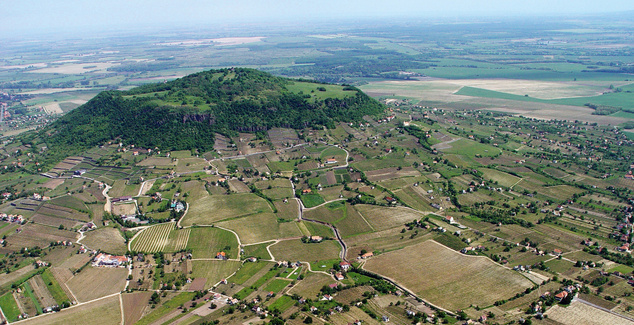
I've just visited one of the world’s most unique wine districts---it is also one of the smallest.  Hungary’s tiny hill of Somló belongs to an exclusive collection of wine areas around the globe that are totally volcanic (think of Greece’s enchanting Santorini, Sicily's Mt. Etna, the Canaries, or Madeira----all islands).  Somló, however, is an aberration as it is hundreds of miles from the sea.

Ten million years ago Somló was an underwater volcano in a very shallow inland sea.  It erupted and spewed enough molten lava so that it rose out of the sea to a height of nearly 1,500 feet.  The spewed mineral-rich lava was mixed with bubbling gasses from super-heated air deep in the earth’s strata.  The gas penetrated the cooling magma into relatively crumbly, coarse soils that have eroded over the millenniums.  These friable soils today allow water to be delivered to the roots of vines very slowly, a lifesaver during a dry growing season when vineyards must rely on groundwater to survive. The coarse soils are also fast-draining, perfect for vines.  Equally compelling, the mineral-laden soil also contributes interesting minerality to the wine.

Although Somló is a mere 1,200 acres, the hill has over 1,200 individual wine-producers.  This is special soil and everyone for miles around wants a piece of the action.  There are only two sizable producers;  everyone else is a boutique winery, or simply making a wine for home consumption.

Somló is white wine country.  Pronouncing the grape varietals can be a challenge (Juhfark, Olaszrizling, Furmint and Harslevelu---the latter two of which are also the grapes of Tokaj.).   But, drinking these magical white wines is pure bliss.  I’m charmed by Juhfark’s  brilliant, deeply concentrated yellow color and its almond-like finish; Olaszrizling’s high-acidity;  Furmint’s honey and white flower essences; and Harvslevelu’s liquid sunshine of melons and citrus.  Wet stone nuances abound in all.

Blue Danube Wines is the exclusive importer for all Somló wine to the USA.  While Somló may be a little wine district, its white wines are huge in pleasure.  Looking for something new and enticing for a dinner party?   Somló could be your crowd-pleaser.