Friday, October 28, 2016

Brownie Points

                                                           
                        Invented over a century ago, the brownie remains an American classic.

I admit it.  I’m a sucker for a great fudgy-ooey-gooey brownie.  In fact, it would be on the menu of my last meal.  Did you know that the modern day brownie originated > 120 years ago at the Palmer House Hotel in Chicago?  Here’s the story.

The Palmer House has been an iconic property since 1871.  Famous on many fronts other than inventing the brownie, the hotel completely burned to the ground in Chicago’s Great Fire a mere 13 days after it opened.  Two years later the Palmer House rose from the ashes and made headlines:  it was the first hotel to use Edison’s recent invention, the light-bulb.  Moreover, it was the first hotel to use Bell’s invention, the telephone.  But, there’s more.  It was the first to use the “vertical railroad,” which we call today the elevator.  Now, for the hotel’s real star, the brownie.

This ethereal chocolate dessert was concocted in the kitchen of the Palmer House hotel in 1893, the year of the World’s Fair in Chicago.  Bertha Palmer, wife of the hotel’s owner, was involved in orchestrating the women’s activities at the Fair.  Mrs. Palmer asked the chef of her hotel to make a “ladies dessert:”  one that would be easier to eat than a piece of pie, was smaller than a slice of layer cake, and one that could be transported without issues to the Fair.  As Mrs. Palmer loved chocolate, it was a no- brainer for the chef. The brownie was born. 

This recipe, created over a century ago, is still served today at the Palmer House Hotel.  It remains one of their most popular desserts.  Check it out:

Brownie Ingredients:
1 lb  high quality, semi-sweet chocolate
1 lb butter
1.5 cups sugar
½ cup cake flour
8 eggs
2 cups chopped, toasted walnuts

Glaze Ingredients:
1 cup water
1 cup apricot preserves
1 teaspoon unflavored gelatin

Brownie & Glaze Instructions:
·        Preheat oven 300 degrees.
·        Butter & flour 9 x 12 pan. 
·        Toast walnuts in skillet, stirring and watching carefully so they don’t burn.  Cool. 
·        Melt chocolate and butter in double boiler over very hot water. 
·        Meanwhile, mix dry ingredients (without walnuts) in mixing bowl. 
·        Mix melted mixture with dry. 
·        Wisk in eggs, one at a time, beating about a minute for each egg.
·        Place in prepared 9x12 pan.
·        Sprinkle brownies with toasted nuts, pushing down to partially submerge.
·        Bake for about 35 minutes until there’s a 2 inch crispy brownie edge---the interior will be slightly jiggly.
·        Remove and let cool for 30 minutes.
·        Prepare the glaze by mixing water, preserves & gelatin in saucepan over medium heat.  Whisk until boiling, then boil for 2 minutes.
·        Spread a thin layer of the hot glaze over the cool brownies, then cool completely.
·        Place in the freezer for 3-4 hours. 
·        Slice and serve while very cold and firm.


Friday, October 21, 2016

Your Own “Personal Terroir”


                                      Science shows that each person smells different aromas

If you’ve been on a Wine-Knows trip, you know the word terroir works its way into the conversation several times a day----it doesn’t matter if we’re in the Southern or Northern hemisphere, or it’s a trip to Bordeaux, Tuscany or Australia.  To remind you, terroir is a French word that has no exact translation.  It is the sum of all parts that go into making a wine unique:  everything from the soil in which the grapes are grown, the micro-climate, the drainage of the vineyard, and even the pests in the local environment.   Is there such a notion of one’s "personal terroir?"  Is there something unique about each person that effects our perception of a wine?

Scientists in Spain believe there is.  Research has demonstrated that there is a physiological reason for the perceived differences in the aromas that we smell in a wine.  The reason has to do with our unique microbes that live inside saliva.  A minimum of 700 different bacteria live in our saliva and mouth.  No two persons’ makeup of these bacteria is exactly the same. The microbes are involved in chemical reactions resulting in different aromatic compounds in wine. Different bacteria cause different reactions and ultimately different smells for different people.

While more research is necessary to explore this notion of a personal terroir, the door has been opened to explore the idea as the olfactory equivalent of our fingerprints.  No two people smell exactly the same due to the difference in their unique bacteria makeup.  Next time the person next to you swirls a glass of Cabernet and speaks of “leather and cigar box” and you smell “chocolate and spices” it could very well be due to your personal terroir. 


Friday, October 14, 2016

Got Gruner?

                        Wine-Knows will be staying in this fairy-tale Danube village on its 2018 trip

I’m just home from a whirlwind trip to Austria & Hungary----a “reconnaissance” for the 2018 Wine-Knows’ harvest trip to these two countries.  While I had visited Austria and Hungary some years ago, profound changes have occurred in the countries, including changes in their wine industry.  What hasn’t changed in Austria, however, is that many of its wine districts continue to be Gruner-centric. 

Gruner Veltliner is flat-out a spectacular varietal.  While it has long been a favorite choice of many fine-dining sommeliers, this white grape could become the next Holy Grail of the wine world.  Blind tastings of “Gruner” by international experts have shown that Gruner can outrank top white Burgundies such as Montrachet and Corton Charlemagne.  In fact, professional tasters often mistake top Gruners for white Burgundy (Chardonnay).

One out of every three vines in Austria is Gruner Veltliner.  The grape has a long history in the country as the Romans were vinifying it shortly after the birth of Christ.  It achieves rock-star status, however, in the region of the Danube River on steep, gravel terraces.  Gruner is a beautiful melding of minerality, along with a profusion of seductive peach and nectarine in best vintages with beautifully ripe grapes.  But, in years of less sunshine, Gruner’s citrus mélange mixed with gentle spices also makes an attractive wine.  Regardless of vintage, the varietal offer gorgeous acidity to make for a gorgeously balanced wine.

Got Guner?   If not, you must search out the following which were my favorites on the trip that are available in the USAAll are family owned and operated wineries.  Each represents a superb quality – price ratio, with Muller being a steal for the price.  All are from Austria's castle-dotted northern Danube area just west of Vienna where Gruner reaches its pinnacle.

Listed in alpha order:

~  Bernard Ott:  Stein and Rosenberg (both 2015)

~  Hirtzberger:  Axpoint (2015)

~  Muller:  Kremser Kogl (2015)


~  Salomon Undorf:  Pfaffenberg (2015)  


Friday, October 7, 2016

Volcano Wines in Hungary?

                                       Wine-Knows will be touring Hungary in 2018

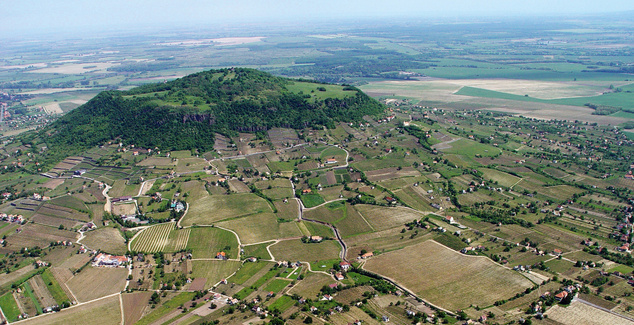
I've just visited one of the world’s most unique wine districts---it is also one of the smallest.  Hungary’s tiny hill of Somló belongs to an exclusive collection of wine areas around the globe that are totally volcanic (think of Greece’s enchanting Santorini, Sicily's Mt. Etna, the Canaries, or Madeira----all islands).  Somló, however, is an aberration as it is hundreds of miles from the sea.

Ten million years ago Somló was an underwater volcano in a very shallow inland sea.  It erupted and spewed enough molten lava so that it rose out of the sea to a height of nearly 1,500 feet.  The spewed mineral-rich lava was mixed with bubbling gasses from super-heated air deep in the earth’s strata.  The gas penetrated the cooling magma into relatively crumbly, coarse soils that have eroded over the millenniums.  These friable soils today allow water to be delivered to the roots of vines very slowly, a lifesaver during a dry growing season when vineyards must rely on groundwater to survive. The coarse soils are also fast-draining, perfect for vines.  Equally compelling, the mineral-laden soil also contributes interesting minerality to the wine.

Although Somló is a mere 1,200 acres, the hill has over 1,200 individual wine-producers.  This is special soil and everyone for miles around wants a piece of the action.  There are only two sizable producers;  everyone else is a boutique winery, or simply making a wine for home consumption.

Somló is white wine country.  Pronouncing the grape varietals can be a challenge (Juhfark, Olaszrizling, Furmint and Harslevelu---the latter two of which are also the grapes of Tokaj.).   But, drinking these magical white wines is pure bliss.  I’m charmed by Juhfark’s  brilliant, deeply concentrated yellow color and its almond-like finish; Olaszrizling’s high-acidity;  Furmint’s honey and white flower essences; and Harvslevelu’s liquid sunshine of melons and citrus.  Wet stone nuances abound in all.

Blue Danube Wines is the exclusive importer for all Somló wine to the USA.  While Somló may be a little wine district, its white wines are huge in pleasure.  Looking for something new and enticing for a dinner party?   Somló could be your crowd-pleaser.


Friday, September 30, 2016

Mad About Tokaj

    A special micro-climate of wet and warmth creates the perfect environment for Botrytis.

I landed in Hungary a few days ago and I'm currently in the town of Mad, deep in the heart of the Tokaj ("TOCK eye") wine district.  A few hour’s drive east of Budapest, this wine country is is so special that the entire district was declared a World Heritage site by UNESCO. Everything is wine-centric in Mad, including things such as the "Botrytis" Hotel. Golden ripe fruit is hanging on the vines and the autumn colors are painting the leaves.  Magic is about to happen.

Tokaj (or Tokay) is the sweet wine made in the Tokaj wine region.  It’s the world’s oldest botrytized wine.  Botrytis is a fungus that attacks sugar-laden grapes with the help a special micro-climate.  During the autumn a morning mist is created by the convergence of two local rivers; and, the wet mornings along with the warm afternoons create the perfect storm for the Botrytis fungus.  Like in the Sauternes district of Bordeaux, “noble rot” (aka Botrytis) thrives in these conditions.  Grapes are attacked by the fungus which bores microscopic holes through the skin of the berry to get the sweet nectar.  What is left is a shriveled, concentrated grape filled with uber-sweet juice, high in acidity (which balances the sugar) and filled with beguiling aromas caused by the interaction with the noble rot. 

People in the Tokaj district long ago recognized they had a very special sweet wine like no other.  In 1757 the monarchy made a law that established geographical boundaries for the sweet wine region.   This was the world’s second appellation system (Chianti, the first, was legally demarcated in 1716.)  Tokaj didn’t stop there, however. Vineyards were then classified based on quality, and it all was approved in 1772.

From the 17th to 19th centuries Tokaj graced the tables of royalty throughout Europe.  In the late 1800’s, however, Tokaj fell victim to the phylloxera bug that destroyed the vineyards throughout Europe.  World Wars I and II didn’t help.  Nor did Communist rule.  Knock-off Tokaj from other countries further worsened the situation.

But, Hungary is on the move again supported by moneys from the European Union to reinvest in its prized Tokaj wine district.  The E.U. has cracked down legally on others in Europe using the protected name Tokaj.   Moreover, the E.U. has recently invested 330 Million Euro for viticultural improvements moving the local wine industry into the 21st century.

Nectar coming from the Tokaj region’s grapes is mentioned in Hungary’s national anthem---a testament to the importance of its sweet wine.  A deep Topaz in color, these luscious wines are truly a golden national treasure.  Tomorrow I head to the actual village of nearby Tokaj so stay tuned for my "mad-about" favorites from this special region. 


Friday, September 23, 2016

The Ambiguity of Wine


If you’re a serious wine lover you have no doubt heard about the tasting that changed the wine world---the Judgement in Paris.  There have been books written about it and movies made about the tasting that turned the wine world upside down when two American wines (a Napa Cabernet and a Chardonnay) beat out many costly Bordeaux & White Burgundies.  But, have you heard about the riveting follow-up tasting, the Judgement in Princeton?

This second tasting closely modeled the original 1976 event in Paris.  The tasting was blind.  Several of the iconic Bordeaux vineyards (e.g. Chateaux Mouton- Rothschild and Haut-Brion) were represented.  The nine judges were French, Belgian and American wine experts.  This tasting also had a huge twist.  The American wines were all from New Jersey.  While French wines won in both red and white categories, they narrowly squeaked by wines that cost pennies on the Euro of the French wines.  It is interesting to note that the two winning French wines were ranked in the last position by at least one of the judges.  Moreover, wines like Mouton-Rothschild received scores all over the map:  some judges rated it as low as 11 (out of 20), while another rated it 19.5. 

So what do these two hallmark tastings tell us?   When tasted blind, world-class wine is in the eye of the beholder.  But, hold on, there’s more.

The University of Bordeaux gathered over 50 wine experts for a mischievous tasting and asked them to give their opinion on two glasses of wine:  one was white, the other was red.   What the connoisseurs didn’t know was that they were both the same white wine—red coloring had been added to one.  Several of these knowledgeable wine lovers described the red-colored wine with words such as “jammy” or “red fruit.”

Another experiment from the same researcher at the University of Bordeaux was even more damming.   This time he upped the ante by taking a middle of the road Bordeaux and pouring it into two different bottles:  one had the label of a fancy Grand Cru chateau, the other a label of an ordinary “table wine.”  If you’re following the drift of this article, it will be no surprise to you to learn that the experts described the Grand Cru bottle with illustrious words indicating a pedigree, while the exact same wine poured from the table wine bottle was referred to as “faulty,”  “weak,” or “light.”


Preconceived notions play a big part in wine and that is exactly why I prefer to taste everything blindly.  These studies also point out another salient point:  if wine experts can’t often tell the difference between a several hundred dollar bottle of wine and one that cost less than twenty bucks, why pay for the more expensive one?  Even more important, relying on expert opinions may not be your best bet in deciding on what wine to purchase.  Trust yourself and purchase bottles you enjoy!


Friday, September 16, 2016

Huge Changes in Bordeaux

                      Bordeaux was chosen as Europe's "Top Toursit Destination"


I just arrived in Bordeaux.   Although I was here in 2012, this town has shifted completely on its axis.  On my first visit in the early 1990's Bordeaux was a forlorn city scarred by run-down, abandoned warehouses along its vast river.  There was little tourism except for wine business folks who occasionally were forced to overnight at one of the city’s lack-luster hotels.  Even in 2012, the dining scene was equally uninspiring.  Yes, there were a handful of good restaurants, but they were old-school spots that had been serving the same menus for decades.   Today, the warehouses have been replaced by a $90 million cultural center.  A bazillion Euros of tourism monies are now flooding into the once forgotten city.

                        Once delapidated warehouses now house chic boutiques & bistros

“Build it and they will come” is certainly the motto for Bordeaux.  The city’s drastic redevelopment of its entire waterfront now offers a plethora of tourist activities.  The biggest and brightest of all is the Cité du Vin (“the City of Wine”).  Ten years in the making, this museum-cum-cultural-events center contains a series of multi-sensory wine exhibits, along with a wine store selling selections from practically every corner of the globe. There are several restaurants with mind-boggling selections of wine, a wine bar, gift shops, and even a bookstore.  Tourists are in every nook and cranny of the town.  The Euros are flowing, along with the wine.

                             Rooms of the Grand Hotel overlook the tony Grand Theater

Hotels have joined in the town’s major cosmetic makeover. The 5 star Grand Hotel spent nearly $70 million to redecorate.  Smaller properties, equally focused on the sophisticated traveler, have followed.  Luxurious boutique hotels are springing up like morels after a spring rain.  Restaurants are following suit with cutting edge chefs flocking to the town to open temples for a new age cuisine.  Gordon Ramsay arrived in 2015 and already has two Michelin stars.  Tonight I'm dining at a just-opened farm-to-table place whose young chef has received raved reviews.  On today's walk I spotted countless new upscale wine bars, bistros and sidewalk cafes.  Fusion cuisine and food trucks appear to be the new norm.

                                                  This could be Paris, non?

But, the downtown area is not all that is new in the world’s most famous wine district.   Wineries has joined in the revitalization by establishing wine routes for tourists.   More wineries are opening hospitality programs to welcome visitors for wine-tasting.  One of the most compelling change in the wine industry, however, is the quest for new varietals.  Global warming is wreaking havoc in Bordeaux.  Researchers are experimenting with <50 new varieties.


The Wine-Knows' harvest tour begins tomorrow.   None of the participants have ever been to Bordeaux so they won't be able to totally recognize the incredible metamorphosis.  One of my jobs, henceforth, will be to ensure they appreciate the transformation of a once ugly step-sister into a glam-Cinderella.