Friday, March 17, 2017

Pisco Sour

                                                         Chile's beloved aperitif

I am with a group of Wine-Knows touring the vineyards of Chile.  There’s only so much wine one can drink.  Besides, who could ever pass up another of Chile’s super-stars, its Pisco Sour?  Made from a type of grape brandy, this stunning aperitif has it all going-on!

The Pisco alcohol actually originated in Peru, but is now made today by both countries.   Spanish settlers in Peru in the 16th century began distilling the left-over grape must into a high-octane alcohol to mimic their native country’s brandy.  Soon its neighbor Chile began producing the spirit.  While Peru currently out produces Chile 3:1, Chile has much more stringent production rules for its Pisco.  In fact, Chile’s Pisco has its own D.O. zones---Pisco can only be produced from grapes grown in these two specific geographical areas of Chile.  Moreover, there are many Chilean laws to ensure quality.

There are many cocktails made from Pisco but my favorite by far is the Pisco Sour.  Think a type of blended margarita where Pisco replaces Tequila.   Another difference is the addition of an egg white (which thickens the texture but doesn’t have much influence on the taste).  The Peruvian version has the addition of bitters, however, the Chileans leave out this component. 

Need a recipe?  Check it out:  http://wineknowstravel.blogspot.com/search?q=pisco

The good news is that you don’t have to go to South America to enjoy a Pisco Sour.  It is becoming more and more popular and is available in many liquor stores (BevMo carries it). 


Viva Chile!

Friday, March 10, 2017

Chilean Sea Bass—It’s All About Marketing

                                         The Patagonian Toothfish is a cold water Cod

I leave in a few days for Chile.  One of my favorite foodie stories about this country has to do with Chilean Seabass.   Many of us enjoy the buttery flavor and unctuous texture of this fish.  I wonder, however, how many know that its true name is not even close?

Have you ever heard of the Patagonian Toothfish?  How appetizing does this sound? Would you be tempted to order a Toothfish of any type?  Chilean Seabass is a fantasy name created in the 1970’s as a marketing ploy to get Americans to purchase the Patagonian Toothfish.  And, it was an American fish importer who dreamed up the new name.  He was debating between two possibilities to entice the American consumer:   “Pacific Seabass” and “South American Seabass,” but in the end chose Chilean Seabass as he thought the specificity might be more attractive to consumers.  The rest is history.

You may also be surprised to learn that Chilean Seabass is not a member of the bass family, but is part of the icefish cod family.   This cod group is only found in very cold waters, including the deep part of the Artic.  (In fact, most of the Chilean Seabass brought into the US now is not Chilean, but from the Artic).  A few more surprises:  Did you know that this fish can live up to 50 years of age?  How about that it can grow up to >200 pounds?  Or, 7 feet in length?

What you do know about Chilean Seabass is that it’s not the kind of fish that would be served at a fish and chips kind of place, at least today.  Instead, it’s more likely to be served at a restaurant featuring the likes of lobster risotto or a luscious kobe beef.  That being said, in the 1980’s it was used by restaurants that could no longer afford halibut for its fried fish sticks.  Over the course of some 30 years, this fish has moved from Chinese restaurants looking for cheaper fish, to la crème de la crème dining establishments.  It really moved from total obscurity to Bon Appetit’s dish of the year in 2001.  


Chilean Seabass worked its way up the food chain due to a brilliant branding and marketing campaign.  Let’s raise a glass to the forgotten Patagonian Toothfish, and to the power of a name. 


Friday, March 3, 2017

Chilean Wine Beats Pricey Bordeauxs!

                          Errazuriz beat out Chateaux Haut-Brion, Lafite-Rothschild & Opus One.

I’m on my way to Chile with a group of Wine-Knows.  One of the first things I intend to discuss with the group is the findings of a blind tasting by 100 of New York’s top wine critics, sommeliers and retailers.   It was like the “shot heard round the world,” but, not terribly surprising since Chile has really upped its quality game in the last ten years.  The country is producing some world-class wines.

In an experiment similar to the famous Judgement of Paris in which California wines were blind tasted against the best of France (and won!), Chile conducted a similar tasting against some of France, Italy, & American's super-star reds.  Chile beat out Bordeaux’s highly revered Chateau Haut-Brion, as well as Chateau Lafite-Rotchild (both of which sell for $500 more).  It also beat out Tuscany’s most famous wine, Sassicaia, the price of which also exceeds Chile’s champion.  The victor, as well, beat out California’s cult classic, Opus One.

The wine that took this tasting by storm was Errazuriz’s Kai.  Not cheap by Chilean standards, it sells for < $150 per bottle in the US.   Another surprise is that it’s made from a little known Bordeaux grape, Carmenere.   Ironically, very little of this varietal remains in Bordeaux today as the phylloxera bug wiped most of it out in the late 19th century.  Chile’s Carmenere was thought to be Merlot for many years until DNA analysis showed it to be the “lost” varietal from Bordeaux.

Out of the Top Ten wines in the Big Apple's blind tasting, Chile placed not only first, but also 4th, 6th and 9th.  (Amazingly, the 4th and 6th slot winners were both produced by Errazuriz).  The Chilean winners are all available online but sell for >$100 per bottle.  If, however, you’re looking for a less costly but very well-crafted Chilean wine  you should try Purple Angel by Montes ($60-70; Costco for $50’s).  It’s made from mostly Carmenere so you could kill two birds with one stone:  taste a superlative wine, and begin exercising your Carmenere muscle.


Viva Chile!


Saturday, February 25, 2017

A Magnifico Condiment from Italy

                                                 Mostarda di frutta is quintessential Italian

Have you ever heard of mostarda di frutta?  If you’ve been in Northern Italy during the winter there’s a very good chance it’s been on many restaurant menus as an accompaniment to a meat dish.  Mostarda is major flavor bomb.  It is often served with the classical bollito misto (an over-the-moon tasty assortment of boiled meats), however, it can also be found as a side relish with cheeses that can take its sharpness.  I’ve even seen it served to the side of sausages, or even spooned over fish. 

I think of mostarda somewhat like an Italian version of chutney.  While some may think because of its name that it’s a type of mustard, it is not.  (It does, however, have mustard oil as an ingredient).  Although it has sugar and fruit, it is definitely not a jam or jelly---and it is not sweet.  It has cayenne, but it is not spicy.  It’s not salty or acidic. In fact, it’s none of these things alone.   It is, however, a unique combination of sweet and savory, salty and spicy, with just enough of an acid backbone.

Often referred to as simply “mostarda,” this yummy condiment can easily be made at home, or can be purchased online or in upscale markets such as Whole Foods.  It can be made with a variety of fruits (although the area in which it originated often used quince and grapes in the beginning).  I’ve seen it made with everything from cherries and figs, to plums and even citrus.

Mostarda di frutta is uniquely Italian.   It’s also a classical wintertime condiment.  Why not have a bollito misto party ?  (Similar to a fondue party only with bollito misto placed in the center of the table in the pot in which it was boiled.)  Bring out some great Barolo or Amarone and invite a group of Italophiles over for a night of wining and dining.  I guarantee you that everyone will go wild over the mostarda!


Buon appetito.


Sunday, February 19, 2017

Presidents & Wine

                                           The birthplace of American Wine
                       
Tomorrow is President’s Day.   Did you know that several Presidents were instrumental in shaping the course of wine in our country?  Several of our founding fathers were not only involved in efforts to ensure life, liberty and the pursuit of happiness, but were real bon vivants with deep appreciation of fine wines. 

Let’s start at the beginning.   George Washington drank 3 glasses of wine after dinner. While this wine was a Portuguese Madeira (a very “in” wine at the time), he was also quite interested in French wine with dinner.  Washington’s wine cellar included many chateaux still famous today, such as Mouton-Rothschild and Yquem.  Way to go, George!

Thomas Jefferson had a profound influence on the American wine industry.  Out of all the Presidents, Jefferson was certainly the most passionate about wine.  As the Ambassador to France, Jefferson toured many of the country’s most illustrious chateaux---his favorites were Burgundy and Bordeaux.  I was recently at Chateau Haut-Brion in Bordeaux and in the entry way of the chateau was an oil painting of Jefferson.  According to records, Jefferson sent home thousands of bottles from the area for him and his friends, one of whom was George Washington.  

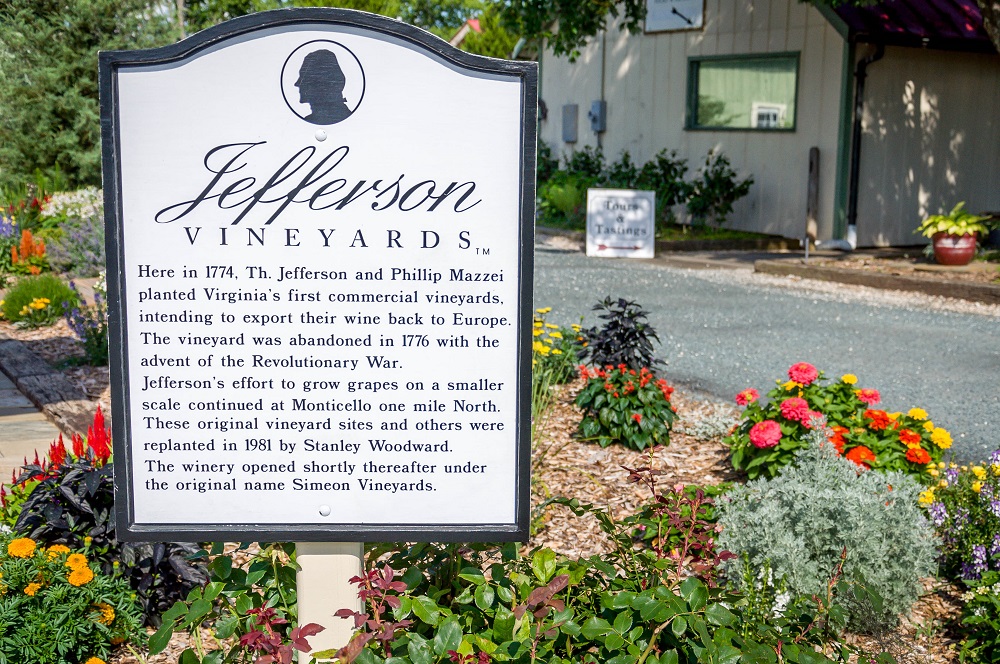
Jefferson, however, was much more than a consumer of French wine.  A definite wine geek, he took copious notes on the different French terroirs (soil types, drainage etc.). Moreover, he was the first American to attempt wine-making.  Jefferson brought home cuttings from France and began growing grapes for his own wine-making at Monticello.  He was certainly a dude with whom I would want to hang-out.

Fast forward >150 years to the Presidency of Richard Nixon.  While Nixon’s ethics and politics don’t leave one with a warm and fuzzy feeling, he was undeniably a wine aficionado.  At a time when jug wine and cocktails were the norm, Nixon drank the real-deal Champagne and Bordeaux.  Fine wines apparently put a big dent in his entertainment budget.  Considering it was tax payer dollars funding this, however, this may be another nail in his coffin.

Ronald Reagan loved wine.  Prior to Reagan, mostly French wines were served at White House special dinners.  But Reagan, who was especially crazy about wines from his home state of California, changed all of that.  At a time when the California wine industry was beginning to shine, Reagan helped further promote it on a more global scale by serving it to some of the world’s most prominent leaders.   BV Private Reserve was served to Prince Charles, while a Jordan Cabernet was on the menu at another dinner honoring Queen Elizabeth.  Nancy Reagan, on the other hand, was wild about Kendall-Jackson Chardonnay and it frequently was served at White House events.

Have a Presidential Day.


Sunday, February 12, 2017

A Special Valentine’s Dessert

                                                              This cake is Southern Living’s most requested recipe

If you’re looking for a scrumptious way to celebrate Valentines, I’ve got just the recipe for you.  I had my first bite of this ethereal cake in Charleston two years ago when I took a group of Wine-Knows to Savannah and Charleston.  One of my clients ordered it at dinner and made the mistake of giving me a taste.  It was love at first bite.  I tracked down the next day the bakery , bought a huge piece (which I devoured on the spot), and have been a fan of the “Hummingbird Cake” ever since.

If you like homemade carrot cake (the moist version with pineapple and coconut), you’ll love this dessert.  Think carrot cake meets a great rendition of banana bread.  Published in Southern Living in 1978, Hummingbird Cake is the most requested recipe in the magazine’s <50 year history.  Over the years the cake has garnered a plethora of awards, including First Place at the Kentucky State Fair.  Just about every women’s Community Cookbook in the South has at least one recipe for this famous sweet.  Google currently offers nearly a million recipes---including one by the Queen of Southern cooking, Paula Deen.  There are even Hummingbird Cake videos on U-tube.

In spite of this cake being so strongly associated with the South, Hummingbird Cake actually originated on the island of Jamaica.  It appears the recipe was part of a marketing ploy in 1968 when Jamaica Airlines was launched.  The airline’s press package included various items about the island’s culture in hopes of enticing tourists to come to Jamaica.  Part of that press kit was the Hummingbird Cake, named after the island’s national bird.

Here’s the original recipe published in Southern Living


Have a sweet Valentine’s!


Friday, February 3, 2017

French Fizz Ed

                                          Fizzy Crémants can be great values 

If you’re looking for a reasonably priced bottle of French sparkling wine you should consider the country’s Crémants.   The word “Crémant” was adopted by regions outside of the Champagne district to distinguish their own fizzy wines after laws were enacted to prohibit other areas from using the word Champagne.  (Crémants, however, are made by the exact same process as a Champagne).  Crémant means “creamy” and refers to the fizzy wine’s texture.  Here are a sampling of some of the best regions for Crémants.  


Crémant d’Alsace

Alsace, which shares its western border with the Champagne region, is the largest producer of Crémant in France.   Crémant d’Alsace is made with Chardonnay and Pinot Noir (the same grapes used in Champagne), as well as Pinot Blanc and Riesling. 


Crémant de Bourgogne

Burgundy shares its northern border with Champagne.  Made mostly from Chardonnay and Pinot Noir, these fizzy wines can be excellent values.  Add a tablespoon of Burgundy’s Crème de Cassis and you have the region’s famous aperitif, a Kir Royale.


Crémant de Loire

Crémant de Loire was the first Crémant appellation to be recognized in France (1975).  Chenin Blanc, the hallmark white grape of the district’s still wines, makes many of the Loire’s best bubbles.  This fizz pairs perfectly with the area’s coveted oysters.


Crémant de Bordeaux


A fizzy wine in Bordeaux?  The sparkler is only a tiny fraction of this region’s production…and it rarely leaves Bordeaux.  The white version is made from Sauvignon Blanc and Semillon, the rosé from Merlot, Cabernets Sauvignon and Franc, as well as Malbec.