Wednesday, December 28, 2022

Pizza is Now U.N. World Heritage !

                              Pizza from the city of Naples has been recognized by UNESCO

The art of making pizza has been declared by the United Nations World Heritage (UNESCO) as an official cultural treasure.  Actually, this accolade went to pizza from the city of Naples where this internationally beloved dish originated.   Neapolitan pizza, however, has very humble beginnings in that it was used to feed the poor.


While pizza in Naples can be traced back to the 18th century, bread's history actually goes back to 8,000 BC.  Bread in some form has been instrumental for feeding human societies.  The ancient Roman Empire, however, took the art of bread-making to another level.  Romans not only made enhancements to milling techniques, but were the first to produce flour which could be made into bread.  Naples was an important cultural center of the Roman Empire thus bread-making has deep roots in the Neapolitan cuisine.


      Naple's tomatoes, grown on the volcanic slopes of Vesuvius, taste like to other in the world

One cannot discuss the history of pizza without mentioning the tomato.  First, one has to remember that the tomato wasn’t brought to Europe until the early 1500’s.  It was first brought to Spain from South America by Spanish conquistadores.  It took another 50 years for the tomato to make it to southern Italy.  Thought by many Europeans to be poisonous, tomatoes took nearly a century to catch on.  In Naples, poverty was rampant.  People could starve to death, or try to survive by eating the tomato.  Today, the local tomato San Marzano, has become a world-wide brand.


The first recipe using tomatoes can be traced back to Naples in 1694.  A Neapolitan chef wrote in Latin a recipe for a sauce using tomatoes, onions and herbs.   Even then, this tomato sauce was shunned by the wealthy and viewed as a food for the poor.  Rich Neapolitans ate meat.  Poor people living in Naples ate vegetables, and this vegetable was particularly interesting because it could be preserved through a drying process, in olive oil, or in a paste form.

                Margherita is a classical offering in nearly every pizza spot around the world

While all of the ingredients for pizza were present in Naples for nearly 200 years, it took the visit to Naples by the King of Italy in 1889 to put pizza on the map.  During this visit one of Naple’s chefs created a dish named after the King’s wife Margherita.  The creation cleverly had the 3 colors of the Italian flag:  red, green & white.  Today, this Neapolitan classical pizza Margherita is served at restaurants around the world and includes bread, tomato sauce, mozzarella and basil.


The art of making pizza belongs to the people of Naples who created it in order to survive.  While now an art form around the world, the accolades belong to the humble poor of Naples who had nothing much more to eat than bread, and took a big chance on tomatoes.   Let's remember that in the New Year.


Tuesday, December 13, 2022

Heidelberg: the World's Largest Wine Barrel

          The castle, as seen from the Christmas Market, dominates the entire town of Heidelberg

Heidelberg is one of Germany's (and Europe's) most charming cities.  The city boasts the oldest university in Germany (1386) which has produced eight Noble prize winners.   The university is extremely popular---one in four residents of Heidelberg is a student.    Heidelberg has long been an attraction for great literates including Goethe, Victor Hugo, and Mark Twain.   (Twain wrote much of his Tramp Abroad in the city.)  With its riverbank setting, spectacular old town filled with stunning buildings from the medieval, Gothic, Renaissance and Baroque periods, it is an architectural jewel.  One of the most special buildings is home the largest wine barrel in the world.

                        Original illustration
                    Mark Twain's illustrator captured the cask in the book A TRAMP ABROAD
The mammoth size wine barrel is located in the wine cellar of Heidelberg's iconic hilltop castle.  The castle's construction began in the early 13th century, but there have been numerous centuries of construction efforts.  At one time, the castle was even divided into two separate palaces.  While German Kings in the 1400's claimed the castle as their residence, the next 500 years would bring decay from several fires, along with destructive wars.   There have been multiple attempts at rebuilding and restoration.  Regrettably, the ravages of time and forces of nature have destroyed much of the former castle but, fortunately, there are a few parts of the palace remaining.  Yesterday, Wine-Knows had a private tour of the castle and its still intact wine cellar...home of the monstrous wine barrel.
The castle ruins provide the perfect backdrop for a cup of hot mulled wine.

The world's largest wine barrel was built in 1751 by the King of Bavaria.   At that time it was a status symbol to build oversized wine barrels in Germany.  For example, it was not unusual for towns to attempt to outrival one another with fashionable super-sized wine barrels.  Royalty had their own competition.   The Prince who earlier owned Heidelberg castle was in a rivalry with the Duke who owned Ludwigsburg Palace.   Both built immense barrels to outdo the other.  Everything came to a grinding halt when the Bavarian King built the barrel that was never surpassed---his barrel was in the castle at Heidelberg.
Timbered from 130 oak trees, Heidelberg's barrel holds about 58,000 gallons which translates to nearly 300,000 bottles.  That being said, it is no longer used to store wine.  Over the years, its oak staves have dried out and shrunk causing leakage.  Today, it's simply a display for tourists interested in wine.
                                 The wine cask is so tall that it requires a staircase to reach its top
Thirsty Wine-Knows, however, didn't stop after viewing the barrel.  Instead, we proceeded deep into the caste's cellar which is now a wine cellar restaurant.  As the castle was now closed to visitors, we enjoyed the entire cellar in a  private wine tasting.   All wines were dry one and included some of the area's most highly regarded wines.
Merry Christmas from Heidelberg!

Wednesday, December 7, 2022

Berlin's Enchanting Christmas Markets


         Gendarmenmarkt is one of Berlin's best known markets for discerning food-lovers

Berlin at Christmas time is a winter wonderland for Santa’s elves.  There are >80 Christmas markets spread throughout the city.  Like Christmas cookies, these markets vary in size, color, shape and flavor but there’s assuredly a favorite for everyone.   The largest of these markets have nearly 2 Million visitors during the yuletide season.  Christmas markets in Germany are not only immensely popular with Germans, but with other Europeans and visitors from nearly every country in the world.

   Gingerbread cookies are quintessential items at every German Christmas market

Christmas markets in Berlin have been documented for nearly 600 years.  Records from the early 1500’s indicate that the first markets were divided by the type of products being sold by vendors:  one market was known for selling sweets, another market for selling fish.  Today, the largest markets have as many as 400 vendors selling everything from specialty German holiday desserts to only-made-at-Christmas sausages.  Others offer homemade crafts ranging from jewelry to clothing, and every conceivable type of Christmas ornament.

                   A mesmerizing array of holiday jewelry entices

Yesterday, Wine-Knows visited their first Christmas market, Gendarmenmarkt, located in the epicenter of Berlin on a historic square flanked by the Berlin Concert Hall and two spectacular churches.  Floodlit at night, this square hosts one of the most captivating markets in the city.  A huge stage dominated the square where various artists provided yuletide entertainment heard as we strolled throughout the market.  There was a plethora of goldsmiths with unique jewelry items, artists representing all mediums from sculpture to painting, and even glass-blowers.  There was also a wine bar where strollers could opt for a glass of Champagne.  (Personally I preferred the hot mulled wine, a classic at every Christmas market in Germany.) 

                                      Sausages came in a mind-boggling assortment

The Gendarmenmarkt is one of the top Christmas markets for foodies.  Alongside the made-only-at Christmas culinary specialties such as the labor intensive stollen, this market offered huge heated tents for inside dining that were fully decked out for the holidays.   We saw sausages in every shape and size, many being grilled over wood fires.   No turkeys were in sight….roast goose is Germany’s preferred Christmas meat.  Side dishes included flavor-chocked red cabbage and traditional potato pancakes with a dollop of applesauce.   For dessert there were endless possibilities, the most popular of which was some form of gingerbread such as the Santa-shaped gingerbread cookies.  

                                     Stollen is a yeast bread studded with dried fruits

In contrast, today’s market was a medieval Christmas market in front of Berlin’s mammoth city hall (Rote Rathus).  There were organ grinders and performers in period costumes…all against the magnificent backdrop of an Old Berlin setting in a scene from another century.  One of the most visited Christmas markets in Berlin, this one has a 150 foot tall Ferris wheel with mindboggling views of the city stretching all the way from the Brandenberg Gate to the suburbs, and a gargantuan ice-skating rink.  The market was packed with children as this yuletide extravaganza has a petting zoo, historic carousel rides, as well as a child’s train through a fairy-tale forest.   We arrived just in time to see Santa in his sleigh flying high over the market.

           Christmas markets are a great way to combine culture, sight-seeing, history & shopping

Tomorrow, we’ll be leaving Berlin and moving on to Germany's oldest Christmas market in Dresden.   Nuremberg and Heidelberg will follow .  The we'll end the tour at the grand-daddy of all Christmas markets, Strasbourg, France.  Along the route, there will be wine tasting as well as important cultural visits such as the Court of the Nuremberg trials. 


Schöne ferien.....Happy holidays!


Monday, November 28, 2022

Malta for Food-Lovers


Malta's  weather is a compelling reason to visit...even in late November

Malta was one of the last destinations on my bucket list.  As Malta has the warmest winter weather in Europe, I chose to recover from jet lag here for a week prior to flying to frosty Germany for the Wine-Knows’ Christmas Market tour.  I already feel at home on the island as its gastronomy (and architecture) reminds me of Sicily.   Maltese food, like Sicilian, has Arabesque influences but there are also nuances of France and Spain juxtaposed similarly to Sicily.  All of this makes sense when you examine the island’s history.

                                Dining al fresco for lunch is possible nearly year around

The island of Malta lies less than 60 miles from Sicily and roughly 175 miles from Tunisia.  Like much of the Mediterranean, Malta was first colonized by the Phoenicians who arrived 700 BC.   Sailing from what is now modern day Lebanon, the Phoenicians ruled Malta until 200 AD when the Romans sailed in and changed the balance of power.  A few centuries later the Moors (Arabs from northern Africa) appeared on Malta and ended up ruling the island for hundreds of years. In 1000 Malta became part of the large Kingdom of Sicily (which included much of southern Italy).  This was followed by a period of Spanish rule, but in 1530 Spain gave Malta to the Knights Templar, a Catholic military order charged with the care and defense of the Holy Land.

All of these colonizers left their marks on the culinary fabric of Malta with Sicily being the most dominant.  Sicilian influences are everywhere:

Maltese bakeries offer "kannoli" in all different sizes

~ Cannoli are synonymous with Sicily.  A tube shaped dessert, they are filled with ricotta, dried fruit and even chocolate.    

~ Pannetone, a dome-sized sweet bread popular especially during Sicily’s Christmas holidays, is in every store on Malta.  

~ Pasta in every size and shape appears on all menus. 


But, the Arab impact is also palpable:

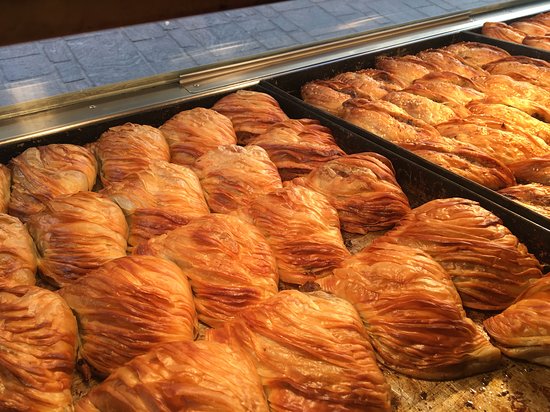
                                  Pastizz is a Maltese national dish with roots in Arabic cooking 

          ~ One of the most popular foods on Malta is flaky pastizz.  Made from layers of phyllo pastry, it is filled typically with ricotta and curried peas.   Think of it as a savory baklava.  Pastizz is a national  dish available everywhere on the island…in pastizz shops, cafes, bars, restaurants and even sold by street vendors.

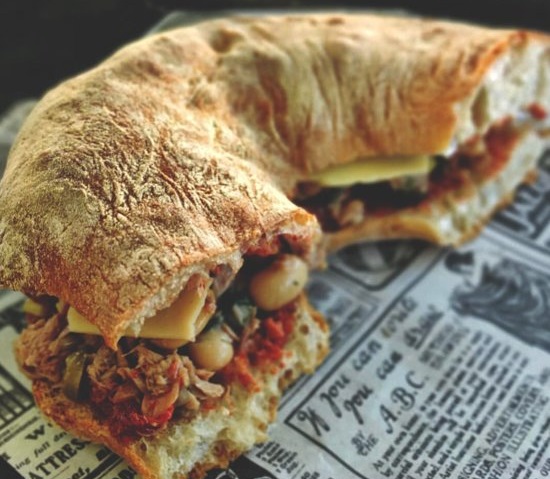
                               My ftira  was filled with tomatoes, capers, tuna & onions

          ~ There are many breads produced on Malta, but none more important than the ring-shaped ftira.  The name ftira is derived from an Arabic word meaning “unleavened bread.”  It’s so important to Maltese culture that it was added to UNESCO’s Intangible Cultural Heritage list recently.

          ~ Malta’s dishes are flavored with a treasure trove of spices brought by the Arabs, including cumin, paprika, curry and mint.

                     Platt Malti is a meze platter and tapas rolled into one yummy experience

          ~ Platt Malti isn’t a dish but a selection of small appetizers commonly known in the Middle East as meze.  This isn’t just a platter of food, but more of a social event and a key part of Maltese culture and cuisine.


The Spaniards also shaped Malta’s gastronomy.  Conquistadores brought to the island all of their New World culinary discoveries:

                  The Malta Chocolate Shop is all decked out with goodies for the holidays

          ~  Malta is thought to have been the first place after Spain (in all of Europe) that chocolate was tasted.      

          ~ Tomatoes are a huge part of the island's culinary landscape.  With the Malta’s moderate winter weather there are tomatoes still growing in some gardens.  Moreover, dried tomatoes are for sale in every shop.  Sun-dried tomatoes in olive oil are a common ingredient on a platt malti.


              Aljotta is a cousin of bouillabaisse....both were brought to Europe by Phoenicians

Let’s not, however, forget the Phoenicians who were the first to arrive.  The Phoenicians were responsible for bringing their ubiquitous fish stew to all of the Mediterranean.  The French call it bouillabaisse, but in Malta it’s referred to as aljotta.  Instead of pricey saffron, the Maltese version uses mint and lemon for final flavoring.

There are >200 bee keepers on this tiny island

Finally, Malta’s culinary profile cannot be discussed without speaking of the root of its name.   Malta means “honey.”   Considered to be some of the best in the Mediterranean, Maltese honey is unique because of the island’s abundance of wild thyme which lends a distinct flavor.  For certain there will be some in my suitcase.


Lovin' Malta!


Thursday, November 17, 2022

Charbono: Noah’s Ark of Nearly Extinct Grapes

               Charbono thrives in climates where there is a huge swing between day & night temps


Charbono has been declared an “endangered” grape by Slow Food.  (The Slow Food movement begin >30 years ago when an Italian food journalist took a stand against fast food by protesting the opening of McDonald’s in the heart of ancient Rome.)   A nearly extinct varietal, Charbono has become somewhat of a cult wine.   First, because it is produced in very limited quantities in the US.   Secondly, it has a loyal following of connoisseurs. 


In Argentina, however, Charbono is surprisingly the most widely planted red grape after Malbec.  In South America (above photo), Charbono is called Bonarda.  It was imported to Argentina by Italian immigrants.  In fact, this dark red grape is thought to have originated in Italy.


                             The Charbono grape is late ripening so it's one of the last picked


Charbono (aka Bonarda), is thought to have first been planted 3,000 years ago by the Etruscans in Italy.   Today, relatively little of the grape remains in Europe with the exception of the France’s Savoie region in the southeast.  Most of these grapes have now taken root in the New World with Argentina leading the production.


Currently there are fewer than 100 acres of Charbono grapes in California.   The most ideal location for the grape appears to be the microclimate of the Calistoga area.  Calistoga is about 10 degrees warmer than lower parts of the Napa Valley, but it’s the cooling nighttime fog brought in along the Russian River that makes this area ideal.  In Argentina, the Andes mountain vineyards also provide for hot days and cold nights.  Known as a “diurnal shift,” these dramatic differences between day and night temperature allow Charbono to ripen but to also keep its acidity. 


           In France Charbono is called Douce Noir & it is grown at the foot of the Alps

So what does Charbono offer in one’s glass?   Its color is a deep inky purple due to the large amount of dark pigments in the grape’s skin.  On the nose, think dark-red and black fruits (e.g. blackberries, cherries and plums) mixed with an interesting mélange of flavors such as licorice and tobacco---that can develop into leather or tar as it age).  In the mouth, the wine serves up flavors of black fruits, medium tannins, and a solid acid structure making it a perfect pairing for foods.


Here are my recommendations for Charbonos/Bonardas to try (listed in order of price):

  • Bodega Aleana El Enemigo Single Vineyard:  $20  (BEST BUY FOR QUALITY)
  • Hobo Wines Folk Machine (California):  $25
  • Familia Zuccardi’s Emma Bonarda  (Argentina):  $35
  • Robert Foley (California):  $45

Buy a bottle before it's too late!


Sunday, November 6, 2022

A Foodies' Calabria


                Tropea is famous for its stupendous beach and for its special shallot-like red onion

Calabria is a region I visited nearly years ago and have always longed to return.  I've just returned home after renting an apartment here for the week in the seaside village of Tropea.  Located all the way at the end of this boot-shaped country (on the western “toe”), Calabria offers >500 miles of dramatic coastline and a particularly strong food culture.  After a month of Wine-Knows’ trips in France, I was ready for some quiet R & R at the spiaggia (beach).


                 Onions and chilies are intricately interwoven in Calabria's culinary tapestry

Agriculture is a big deal in Calabria.  One of the poorest parts of Italy, Calabria’s fertile soil has been extremely important in feeding its population.  Calabria is Italy’s second largest producer of olive oil.  Not only is it a huge economic force in the region, but olive oil is one of the most important items in the Calabrian diet.  This oil has been essential in preserving food for the struggling population: vegetables, fish, and precious meat are all preserved in oil.  While many vegetables are grown, the showstoppers for me were the Tropean red onions, the Calabrese tomatoes, and the eggplant:  a kind of Holy Trinity for my week here.

    Swordfish is plentiful and is often served simply grilled & then finished with a splash of EVOO

Calabrian cuisine is simple and based mostly upon what people can grow or catch in the water or on the land.  As Calabria is surrounded on two sides by the Mediterranean, sea fare has been a popular source of protein.   Swordfish and sardines are mainstays, but clams and mussels are also prevalent.  Rabbit is a standard and is prepared endless ways:  rabbit stew (e.g. with onions, wine & wild herbs or with tomatoes & red peppers), rabbit sausage, braised rabbit with local wild mushrooms, and pasta with rabbit.

                  Bergamot, the flavoring in Earl Grey, is used in pastries & creamy desserts

While Calabrian cooking is simple, don’t mistake simple for mundane.  One of Calabria’s favorite condiments is its chili peppers.  Strolling through villages one notes strings of chilies hanging on balconies to dry in the sun.  Touches of this medium heat chili were present in many dishes throughout the week, adding an interesting depth of flavor and fruity as well as smoky tastes.  By the way, upon returning home I found that Calabrian chili has become so popular that Amazon offers >250 preparations, and Trader Joe’s carries it.  Also, Giada de Laurentis loves this chili….many of her recipes include Calabrian chili paste, and she uses them in her restaurants.

                          Licorice in Calabria is so special that it is protected by the government

Calabria's licorice is nearly sacred.  Both the root and extract have been granted a special protected status by the Italian Government, and only licorice grown in Calabria can be called D.O.P. (protected origin).   Licorice is used to amp up  Calabria's ice creams, cookies, cakes and many other sweets.  There's also a plethora of licorice-infused alcohols varying from digestives to sweet liqueurs. 


Viva Calabria!


Thursday, October 27, 2022

Why do Wines Have a Peppery Smell/Taste?

                   Syrah is one of the most well known grapes for its peppery characteristics

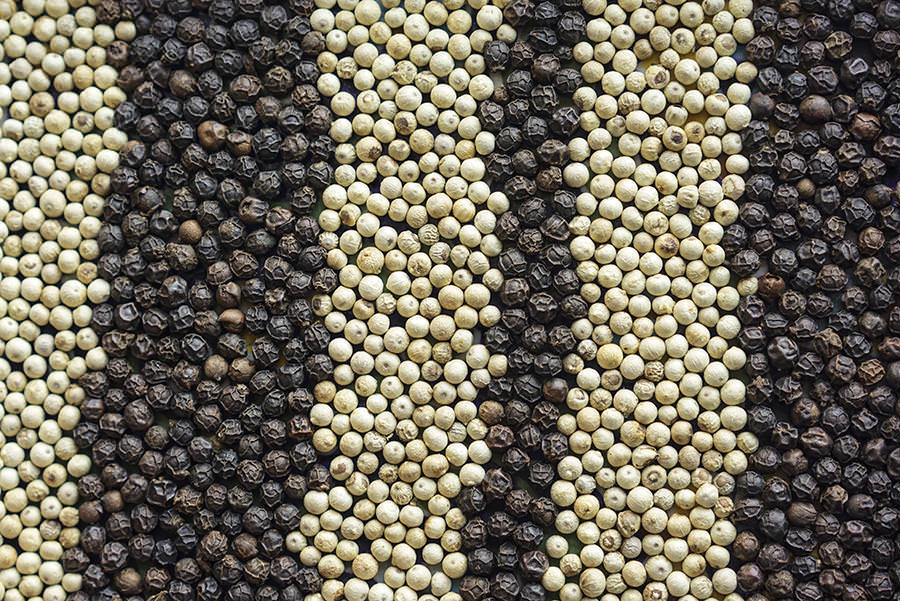
If you’re a Syrah lover (especially those produced in warm climates such as the Rhone Valley), then you’re most likely more than aware of this varietal’s pepper nuances.   There’s a scientific reason for this pepper and it has do with a chemical called rotundone.  This same substance, rotundone, not only appears in Syrah grapes but occurs in both white and black peppercorns.  Unlike many parts of a grape that are changed during the fermentation process, rotundone survives fermentation and ends up in your glass creating a spicy, peppery character.


Rotundone is a relatively newly discovered compound.   It was identified only fifteen years ago by researchers who were on a quest to investigate the science behind the peppery smell in wine.  The chemical, present in the skins of grapes, is found in miniscule amounts.  But, rotundone is such a  powerful aromatic compound that one teaspoon can cause an Olympic size pool to smell like the inside of a pepper grinder.


Both the white pepper smells of cool weather Syrahs, as well as the black pepper of Syrah grown in warmer terroirs are due to rotundone.   And, it’s not only limited to Sryah grapes.  In fact many varietals including Cabernet Sauvignon, Grenache, Pinot Noir and even the white varietal Gruner Veltliner have been discovered to have rotundone.  Interestingly, the rotundone chemical is also present in marjoram and even some cocoa powders, and the smell is also present in well-aged leather.