Showing posts with label Rose. Show all posts

Sunday, May 7, 2017

Rothschild Bubbly

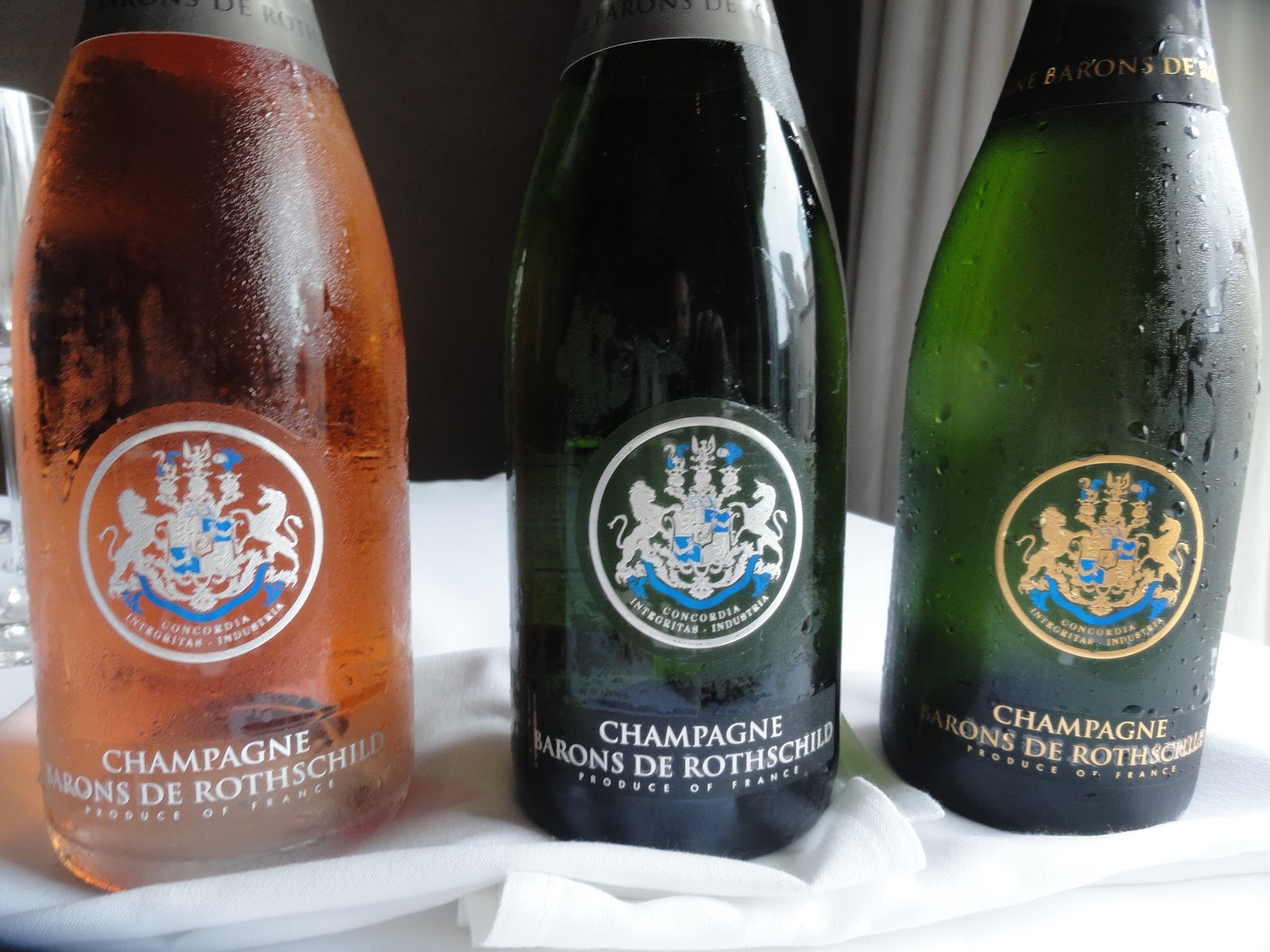
                                                        Rose, Blanc de Blanc & Brut

Champagne made by the Rothschild family?  To those who know French wine this is an oxymoron.   After all, the Rothschild family is from Bordeaux and they only produce the area's Premier Cru red still wine.  By French law, even if the company produced sparkling wine in Bordeaux it could not be called Champagne as only bubbly made in the demarcated area of Champagne in northeast district of France can be called Champagne.  But, the Rothschilds do produce Champagne….read on.

Champagne Barons de Rothschild is made up of three different branches of the family which individually own three different crème de la crème chateaux in Bordeaux: Mouton-Rothschild, Lafite-Rothschild and Clarke.   In 2003 these three branches of the family (often seen as rivals) came together and formed a boutique company with the sole purpose of producing Champagne.  All of the grapes that make their bubbly are from the Champagne region’s top vineyards.

The Barons de Rothschild Champagne was first released in 2015.  I had the good fortune to have one of these early bottles thanks to dear friends who graciously gifted me a bottle for my birthday.  I have never forgotten it and, in fact, blogged about it as one of the best wines I had in 2015.   Last week we had a party to christen a small property on the beach we just purchased.  These same friends showed up with another bottle of Rothschild Champagne.    


There are only 500,000 bottles made each year so it’s not widely available in the US.  However, it is worth seeking out.  You can find it easily online, and upscale area Costco’s occasionally have it.   I’ve had some serious Champagne in my day, but believe me when I say, this is gorgeous stuff.  The wine comes in five different possibilities.  There’s a Brut (made from Chardonnay and Pinot Noir), a Rosé (only Pinot Noir), a Blanc de Blanc (only  Chardonnay), and a 2005 Vintage wine (made only of grapes from this vintage).  I was gifted the Brut.

If you’re looking for a great bottle for a special occasion, look no further.  This wine is the bomb.  


Friday, June 17, 2016

Fizz Ed


There's a plethora of terminology out there related to wines that have fizz which can cause the consumer to scratch their heads.  What the heck does frizzante mean?  How does Prosecco differ from Champagne?  Or does it? Is Cava simply a Spanish version of Champagne?  Does spumante have anything to do with frizzante?  All of these questions are answered below, however, let's start with the basics first.

Sparkling wine is a style of wine which has carbon dioxide bubbles in it.  These bubbles make it fizzy. The most famous example of a sparkling wine is Champagne.  A sparkling wine can be white or rosé, however, there are sparkling wines that are red, such as Italy’s Lambrusco.  Sparkling wine can be dry, or have varying amounts of sugar--- all the way to a dessert wine.  The carbon dioxide fizz is the by-product of fermentation, however, with super inexpensive sparklers carbon dioxide gas can actually be injected into a still wine to make it fizzy.

Champagne 
Only sparkling wine made from grapes in the Champagne wine district of France may be called Champagne.  To protect knock-off sparkling wines, the Champagne Wine Growers Association has a powerful battery of attorneys on staff who carefully watch the use of the closely guarded Champagne name around the globe.   Sparkling wines from grapes grown just a few feet outside the Champagne zone are not allowed to use the name (these wines are called “Cremant.”)  The only exception to the rule is Korbel in California, which was “grandfathered in.”

But, this army of attorneys doesn’t just act regarding wine…any company who uses the name Champagne in any of its products (from hygiene products to car care products) can expect an unpleasant visit from the French lawyers to cease and desist immediately.  Some of those who have had to change their product’s name include well-known perfume-makers, chocolatiers, lingerie designers and soft-drink producers.   Even Apple was paid a visit when word leaked that the company was going to release a "Champagne colored" case for one of its I-phones.  The Champagne name is sacred. 

Prosecco
An Italian sparkling wine made only from a district just outside of Venice, Prosecco is named after the village of Prosecco in which the Prosecco grape may have originated.  Unlike Champagne and Cava, Prosecco does not ferment in the bottle (secondary fermentation), thus it does not have the complexity of Champagne and Cava.  Also, Prosecco is lower in alcohol (11-12%) than many other sparklers.

Frizzante 
Frizzante is an Italian wine term that is closely related to Spumante.  Both describe the amount of effervescence (the amount and strength of the bubbles).  Frizzante indicates a gentle effervescence, or a small amount of fizz.  Prosecco is probably the most well-known Frizzante wine style, though Prosecco wines can also be made in the more robust Spumante style.

Spumante
As discussed above, this term is used in Italy to describe the amount bubbles in a wine.  Think of Spumante as a fully sparkling wine with lots of bubble factor.  The term is often associated with the sweeter wines from the Asti region of Northern Italy, Asti Spumante.

Cava
This Spanish sparkling wine used to be called “Spanish Champagne,” however, it is no longer permitted under E.U. laws.   Like Champagne, there are strict laws on Cava such as the geographical area of where the grapes are grown (near Barcelona), what grapes may be used, and how it is vinified (secondary fermentation in the bottle is a requisite).

 May the fizz be with you!


Friday, March 6, 2015

The Low-Down on Lodi


The Lodi wine district (<1 hour's drive south of Sacramento) has pleasantly surprised me on three occasions.  The first was 15 years ago at a national wine conference in Sacramento when I tasted Spenker Zinfandel.  The second time was a few years ago at a Society of Wine Educator's blind tasting seminar of eight Tempranillos from around the globe---Lodi’s Bokisch Winery stole the show.  The third time was just days ago when I was actually was in Lodi wine tasting.  I was amazed at the quality/price ratio of these sleeper wines.  Below are my standouts.

Oak Farm Vineyards is surrounded by several majestic oaks that are hundreds of years old


Oak Farm Vineyards blew me away.  The drop-dead gorgeous property and visitor center could have easily been located among Napa Valley’s priciest wineries.  (It’s easy to understand why this setting is one the most coveted for weddings in the area.)  But, considering their price point, it was Oak Farm’s wines that truly rocked my world. Their Portuguese  white varietal Verdelho (2013) was a gorgeous aromatic mouthful of honeysuckle and lemon curd---with a nice little finish.  If I lived locally, I would buy oodles of cases to use as our summer wine.  A real steal at $17 per bottle. 

                            Tievoli's label captures the winery's prized 450 year old oak

But, Oak Farm is not a one trick pony.  Their Tievoli (Italian slang for “you gotta have this”) is a blend of several grapes including Zinfandel, Barbera, Petite Syrah and few percent of some whites.  It offers up a soft, elegant wine full of plums and cherries.  While this one had me at hello, its lingering velvet finish sealed the deal.  Another block-buster value for $24. (www.oakfarmvineyards.com)

Bokisch Vineyards stood out again during my recent visit, however, this time it was their 2012 Graciano varietal that earned top honors.  The first US producer to plant this Spanish red grape, Bokisch’s rendition was an enticing play of chocolate and fig mixed with blackberry and gentle spice.  All of  it wrapped up in a bow with silky smooth tannins, this one was ready to drink now.  $23 bucks and worth every cent.  (www.bokischvineyards.com)


For Rosé lovers, Lange Twins Winery stepped up to the plate with a lovely 2014 Sangiovese version.  Think strawberries, raspberries and roses.  Beautiful color and a pretty wine with a price tag of $15.  (www.langetwins.com)

BTW...if you’re in the area, don’t miss Cheese Central in downtown historic Lodi (www.cheesecentrallodi.com).  It’s a gem of a place, with a small but exquisite selection of top rate cheeses.  If you’re staying overnight, consider attending one of the shop's cheese classes that are held in a handsome, professional classroom in the back of the store.  Moreover, if you're passing through Lodi and only have time for one stop, make it the Lodi Visitor's Center wine tasting room (www.Lodiwine.com) which has an excellent collection of wines to taste and a very knowledgeable staff.

Lodi to many wine lovers is an unknown district.   If you know of Lodi wines, you may erroneously think of them as just Zinfandel.  Things are changing.  If you're looking for a terrific price quality ratio, the above producers in Lodi should be strongly considered.  


Friday, June 13, 2014

Take Time to Smell the Rosés


I’ve professed my love affair with dry rosés numerous times on this Blog.  To me they are the quintessential summer aperitif.  But, did you know there are two very different ways to make a rosé?  Let me explain.

The first method is made by simply mixing a white wine with red wine.  For all of you horrified at the thought, chill!  In many parts of France this is a common method.  For example, in Champagne it is quite typical to blend Pinot Noir with Chardonnay.  In the Rhone Valley, mixing red with white is often the norm.  The southern part of the Rhone is home to the illustrious Chateauneuf du Pape.  Red and white grape varietals are allowed in both the reds of Chateauneuf du Pape, as well as the white wines of the region. 

The southern Rhone is also home to the fabulous rosés of Provence.  While Provencal rosé is often made by mixing together red and white wines, it can also be made by the second method, saignée.  Pronouced “sen-yay,” this technique is named after the French work for “bleeding.”   In the saignée method, very young red wine juice that is only pink-tinged is removed from the vat early in the fermentation process.  This pale grape juice is then separately fermented to produce rosé.  In effect, the rosé is “bled” off from the infant red wine, thus the name.

There are arguments for which method produces the best rosé but the proof will be in your glass.   Take some time to smell (and taste) the plethora of available rosés this summer…and decide for yourself.

Friday, June 6, 2014

June Wines


Summer is almost here and for me it means switching to warm weather wines that can easily be served to guests for poolside sipping, enjoyed as an aperitif, or as an accompaniment to dinner as we watch the sunset over the distant Pacific.  Any of the following should add some magic to my namesake-month.

Gruner Veltliner:
Don’t let the name scare you away.  Even if you can’t pronounce it, you need to know it.  An exotic alternative to Sauvignon Blanc, this grape is Austria’s showcase varietal.  Think mango and peach.  With a solid acid framework, this one should float to the top of your June list---and, it’s worth the search.

Vermentino:
I have blogged several times about this Italian bombshell.  Native to Italy’s coastline near Portofino and the neighboring island of Sardenia, this is pure bliss in a glass.  A very aromatic grape, Vermentino offers up a sexy fruit and floral nose, along with a taste profile of citrus laced with pears and apples.  How do you say yummy in Italian?

Dry Rosé:
There are some killer rosés from both California and southern France available.  If you’re in the California mood, look no further than La Crema’s version.  We’ve conducted several blind tastings of rosés over the years and this one always floats to the top. 

Frapatto:
I’m a red wine girl but I don’t particularly enjoy complex, cerebral reds in the heat of the summer.  That being said, I’m wild about the lighter red grape from Sicily by the name of Frapatto.  This one is filled with strawberries and raspberries on the front end, with plums on the back.  

Thursday, April 3, 2014

The Best of the Best---New Zealand


More than 100 wines were tasted on the recent Wine-Knows trip to New Zealand.   As we visited only la crème de la crème wineries, choosing the premier wines is like being asked to pick your favorite Michelin star meal from 2 weeks of outrageously grand dining in Europe or Japan.  Of interest is that only one Sauv Blanc made it on the list.

Below is what floated to the top.  Wines varied from $12 to $80 US and are listed in alphabetical order by producer:

  • 2008 Ata Rangi Pinot Noir:  This winery was one of our Wine-Knows clients’ favorites.  An outdoor tasting overlooking the vineyards with one of the owners and the winemaker…what could be more sublime when you add rock-star wines?  This Pinot, with soft but complex tannins, was an elegant standout. ($60 US)

  • 2010 Bilancia La Collina Viognier:  Maybe it was the drop-dead gorgeous panoramic hillside terrace setting where the wines were tasted?  Maybe it was the oh-so-talented female winemaker that lead us through the tasting of her “babies.”  Maybe it was the unique combination of 85% Viognier mixed with Gewurztraminer (another aromatic bombshell) that created this heavenly mélange?  Whatever it was, it had me at “hello.”  ($40 US)

  • 2013:  Brannock Brae’s Grϋner Veltliner:  This white varietal, little unknown outside of Austria, was just only released from quarantine in New Zealand in 2008.  If this is any example of what the varietal is capable of in the Southern Hemisphere I would say that Grϋner might be the Kiwi’s next Sauv Blanc.  With a nose of peaches and nectarines, tastes of exotic fruits and white flowers, a solid acid backbone, all matched with a lovely finish… this one really stood out.  ($20 US)

  • 2012 Dogpoint  Pinot Noir.  The earth moved on this one, and it may have been the best Pinot of the trip.  A combination of old vines mixed with others, the aromatics were cinnamon and cloves mixed with raspberries.  Roses and blueberries on the taste, along with a very good finish completed this near perfect package.  ($50 US)

  • 2012 Dry River Chardonnay:   This winery’s owner has a PhD in Chemistry from Oxford.  As chemistry is the science of composition and structure, this Chardonnay is a perfect example of complex structure and well composed parts.  With its kaffir lime, melon, pear & vanilla nuances, I can imagine drinking it with everything from Asian to Mediterranean cuisine.  ($37 US)

  • 2011 Fromm La Strada Chardonnay:   This Char garnered “one of the best buys of the trip” award.  Made in the style of un-manipulated French Burgundy, it was all about the more austere mineral profile, with hints of gooseberry and lemons.  The winning element was the finish---impressive at this price point.  ($30 US)

  • 2013 Greywacke Sauvignon Blanc:  It was a real toss-up between this and their 2011 Wild Ferment Sauv Blanc, but I chose this one for its tropical nose versus the Wild Ferment’s slightly vegetal aromatics.  The flavors were grapefruit, lychees and a hint of peaches.   A fabulous finish wrapped it all up with a big bow for me.  ($25 US)

  • 2011 Mt Difficulty Long Gully Pinot Noir.  The outdoor tasting at this knock-out winery was stupendous…breathtaking vistas, gorgeous weather and 10 beautiful wines.   This single vineyard wine was the star of the Central Otago area (the new darling area for Pinot), and one of the best in the country. ($80 US)

  • 2011 Paritua Chardonnay:  I cried crocodile tears when I learned that this one is not exported to the US.  (In fact, China buys most of the winery’s limited production.)  Nonetheless, the long finish of its tropical fruit mixed with nuts really rocked my world.  The winemaker is coming to our home in August for a winemaker dinner…my fingers are crossed he’ll bring this wine.  ($30 US)

  • 2012 St Clair Grϋner Veltliner Block 5:   Although Grϋner is a very food-friendly varietal, I could sip this one all afternoon at our pool on a warm summer’s day….or, serve it as the perfect aperitif.  With an enticing lemon curd nose, it boasted a savory and spice-filled palate and a fairly decent finish considering the price point.  ($25 US)

  • 2013 Unison Rosé:  We had a killer night here at a private dinner composed of a 5 course degustation menu…all paired perfectly with this brilliant winery’s portfolio.  Bone dry, this well-made rosé made from Cab, Merlot and Sryah was matched with a homemade pumpkin tortellini in a tomato and chorizo sauce.   Loved every sip and morsel.  Fabulous buy.  ($15 US)

Thursday, August 8, 2013

Summer Wines


The height of summer is here…farmer’s markets are over-flowing with tomatoes, basil and stone fruits.  With folks taking advantage of every opportunity to eat outdoors there’s always the question of what wine to serve during our hottest month.  While many opt for whites and rosés, there are some excellent, lighter-bodied reds that should not be forgotten.

Casual summer dining at our home around the swimming pool this year will often include one or more of the following:

  • Aperitif:  White Port and tonic.  Even if you don’t care for Port, you’re gonna love, love, love this refreshing drink.  Out of the 16 people who came on our 2011 tour to Portugal, 16 of them were won over by this aperitif!   BTW…white Port is a much lighter version of the dark one (also much less sweet), making it perfect for sipping before a meal! Don’t expect to find it at every liquor store…but it’s readily available online.  Serve it as they do in Portugal…over ice with a twist of lemon (I do a 50/50 combination, however, titrate it to your own preference. ($25)

  • Rosé:  This option is one of my faves, naturally, providing it is a well-crafted wine.  Best one for me?  La Crema’s bone-dry version is unbeatable.  ($25)

  • White:  A client of ours turned us on to this gorgeous wine from the south of France (thanks, Mark).  We’ve ordered cases.  This one offers a superb quality/price ratio, and a unique opportunity to experience a varietal you rarely see in the US:  Picpoul de Pinet by Domaine Felines Jourdan ($15)                             
       Another white option is the sublime varietal Torrontes from Argentina.  If you 
        haven’t tried it, you should.  One sip of this gentle peach-and-white-flower wine 
        and you’ll be hooked.  Best producers?  Try Familia Zuccardi or Altavista. (<$15)

  • Red:   No need to give up reds even on summer’s warmest days.  What you need is a light-bodied red…but, light body does not mean light quality.  My current fave is the Dolcetto grape from Italy’s Piedmont district (home of Barolo and Barbaresco).   Paolo Scavino had the best Dolcetto during my recent trip to Piedmont…and it’s imported!  (<$25) 

Wednesday, December 12, 2012

International Wine Awards Worth Noting


In the US, most oenophiles subscribe to the Wine Spectator, and every wine geek around the globe has certainly heard of Robert Parker.  Many Americans, however, do not know about Decanter, England’s equivalent of our Wine Spectator.  In several ways, I prefer Decanter.  Maybe it’s because of its fresh point of view, or perhaps it’s because of the format.  Nonetheless, listed below are Decanter’s 2012 International Trophy winners that were unveiled in its October issue. (Only those countries that Wine-Knows will be visiting in 2013 have been included, as well as only wines that are imported into the US).

Argentina:

·        Amalaya 2011:  Torrontes (85%), Riesling (15%).  US 

          price <$10

·        Bodegas Salentein Portillo Malbec 2011.  US price <

         $10

Chile:

·        Casas del Bosque Late Harvest Riesling 2010.  US price

           $20

·        Undurraga T.H. Pinot Noir 2010.   US price $25

·        Viña San Pedro 1865 Single Vineyard Sauvignon Blanc

          2011.  US price $19

France:

·        Château Brown 2010 (white Bordeaux blend).  US price

          $35

·        Château Routas Wild Boar 2011 (rosé from Provence). 

           US price $13

Greece:

Although there were no International Trophies, there were two important regional trophies awarded:

  • Gaia Assyrtiko Wild Ferment 2011 (white from Santorini Island).  US price $35

  • Gaia Estate Nemea 2007 (red from Peloponnese Peninsula).  US price $45


For more information, get the full list of Decanter’s 2012 awards at http://www.decanter.com/dwwa/2012/.

Tuesday, July 26, 2011

A rosé for those lazy days of summer

It’s that time of year for some of our faves, rosé.  While we’ve been raving fans of dry French-style rosés for years, it’s thrilling to see that these wines have recently shed their persona non grata image in the USA.   American wine consumers in-the-know have finally discovered that a rosé is not a rosé, is not a rosé.
On our recent reconnaissance trip to Australia for the 2012 harvest tour, we found a very good quality/price ratio rosé made by one of Australia’s leading wineries, Yalumba.   This delicate fruit bomb from Sangiovese grapes delivers a mouthful of ripe strawberries and raspberries, with delicate hints of flowers and mineral nuances.  A decent finish seals the deal, all for the cost of less than $10. 
It may be hard to find (especially after Robert Parker’s recent favorable review), but worth the effort.  We ordered our case of Yalumba Y Series Sangiovese Rose 2010 at www.specsonline.com.