Showing posts with label yeasts wine. Show all posts

Friday, January 26, 2018

Why is Champagne So Expensive?


There are several reasons for the luxury price tag on a bottle of Champagne.  The biggest one is the labor-intensive process in which it is made.   Unlike still wine, Champagne requires several added steps involving significant hands-on toil by a cadre of highly-specialized winery workers.   Moreover, the method of making these hallowed bubbles requires a lengthy period of time.  Time is money.

The unique process of making Champagne is one of the biggest reasons for its lofty price.  Once the grape juice ferments to wine, Champagne goes through an entirely separate process to create its bubbles.  This is called the Methode Champenoise and these words appear on every bottle of sparkling wine made in the Champagne district of France.  By law, no other region or country can use these words, or call their wine Champagne.

The Methode Champenoise involves a “secondary fermentation” in the bottle.  Already fermented still wine is placed in a bottle along with a tiny amount of sugar and yeasts.  A cork is then added.  Over the period of several weeks the added yeast eats the sugar and a secondary fermentation process occurs.   Carbon dioxide is a by-product of fermentation.  This carbon dioxide is responsible for Champagne’s illustrious bubbles.

  Dead yeasts from the secondary fermentation must be removed.

Once the yeast cells have consumed all the sugar they die off.  Now, comes the process for getting rid of the unsightly dead yeast sediment in the bottle.  It begins with “riddling.”  Bottles are placed in a special rack which allows them to be very slowly rotated to a vertical position over time (the cork end of the bottle ultimately ends up at the bottom).  Over a period of several months, each bottle is turned daily by a “riddler.”  Slowly, slowly each bottle is rotated so that over time the spent yeast cells gravitate toward the neck of the bottle. But, there’s much more.
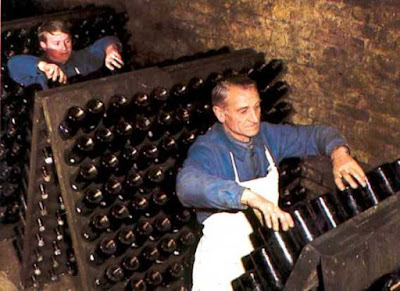
  Riddlers painstakingly turn each bottle daily

Now that the yeasts have all floated to the neck of the now positioned vertical bottle, they must be removed.  This involves another hands-on process called “disgorgement.”  In short, the bottle is kept in its vertical position (cork side down) and placed in ice just long enough for the area near the cork to freeze.  With lightening-speed the cork is removed (and with the cork the frozen dead yeasts adhering to the cork are also removed), and a new cork is placed….all at the blink of an eye by a well-seasoned “disgorger.”    But the Champagne is not ready yet.  It now needs to “rest” for months or even years before it is sold. 

       Dead yeasts accumulate in the vertically positioned bottle & are frozen before removed.

Another reason that Champagne is pricey is the notion of supply and demand.  The Champagne region is the smallest wine region in France and produces a limited number of bottles.  Globally, Champagne accounts for <1% of total wine production.  To further complicate the issue Champagne is France’s most northern wine area.  There are some years in which grapes do not ripen adequately, thus further limiting availability and driving up the cost.

In summary, the Champagne process is long and complex, with many steps along the way that necessitate workers with well-honed special skills.  Production is limited.  All of this translates to do-re-mi for the consumer.   Wine Knows will be visiting both the Champagne and Burgundy regions in June 2019.  For more information about this trip visit www.WineKnowsTravel.com.


Friday, October 13, 2017

Facts Champagne Lovers Should Know

                            A private dinner will be held at the producer of Dom Perignon

Wine-Knows will be taking its last group to Champagne (there are currently 5 spots available on this tour that will also visit Burgundy).  Below is important information that any serious wine lover should know about this oh-so-special bubbly.

Nomenclature
  • Only sparkling wine made in the demarcated Champagne region of France can be called Champagne.
  • Wineries are call "houses."  The Veuve Clicquot company is referred to as the House of Veueve Clicquot.
Grapes
Most Champagnes are a blend of these grapes


  • Champagne may only be made from the above three grapes (from left to right):  (1) Pinot Noir  (2) Pinot Meunier  (3) Chardonnay.
  • If a Champagne is Blanc de Blanc (white Champagne made from white grapes) it is 100% Chardonnay as this is the only white varietal of the three.  The often very slight greenish hue in these Blanc de Blancs is characteristic of Chardonnay wines. 
  • If it's a Rose Champagne, the wine can be made from either or both of the two red grapes allowed.  Rose, however, also can have Chardonnay added.

Taste Profiles
                The entire Champagne region millenniums ago was covered by an inland sea

  • Champagne's limestone is composed of chalky layers, remnants of ancient sea creatures.  These highly porous limestone soils are easily penetrated by root systems of vines heading downward to seek water.  While water is brought up into the plant, so are minerals from the fossilized remains of sea shells.  Due to this, Champagnes offer mineral nuances.
  • Yeasts also play a critical role in the taste profile of Champagne.  Unlike non-sparkling wine, Champagne undergoes a secondary fermentation in the bottle.  Yeasts and a small amount of sugar to "feed" the yeasts are added after the initial fermentation has been completed and the wine has been placed in bottles.  Carbon dioxide is given off during this process but is trapped by the cork in the bottle, thus creating the wine's famous bubbles.   The spent yeast cells add flavors to the Champagne which are described as "bread dough,"  "freshly baked cake," or "brioche."

Land Ownership

Unlike most wine districts where the land is owned by wineries, 90% of Champagne is owned by grape growers.  Only 10% of the land is controlled by actual wineries.


Best Glass
                  Glasses popular in Champagne have tapered tops to enhance the aromas

In the Champagne region of France you rarely see the typical flute glass.  While flutes do help with the visual effect of the bubbles, its narrow top does not fully allow the aromas of Champagne to be appreciated.  While there are many variations, all  glasses in Champagne have the same tulip shape---wider bowls taper (but not near as narrow as the typical flute), allowing one to both swirl and capture the aromas. 

Changing Climate is Problematic

Temperatures in the Champagne region have risen 2.7 degrees Fahrenheit in the last 20 years.  This is especially an issue with fickle Pinot Noir which has a narrow band of cooler temperatures in which it grows.  Moreover, shifting rainfall patterns are posing further problems.

At the same time, England’s climate is also changing, with warmer summer and milder winters.  England is now experiencing a boom in the production of high quality sparkling wine.  More unnerving is the fact that several of France’s famous Champagne houses have purchased land in the south of England.  The country’s southern limestone soil is very similar to that of the Champagne region.


Protecting the Champagne Brand

            Many, from famous perfume producers to lingerie makers, have been successfully sued

An army of attorneys around the globe are employed by the Champagne professional association to protect the Champagne brand.  They’ve done battle with a variety of companies who made the mistake of naming their product Champagne.  A big no-no.


Have a bubbly kind of weekend.