
There are several reasons for the luxury price tag on
a bottle of Champagne. The biggest one
is the labor-intensive process in which it is made. Unlike still wine, Champagne requires
several added steps involving significant hands-on toil by a cadre of highly-specialized
winery workers. Moreover, the method of
making these hallowed bubbles requires a lengthy period of time. Time is money.
The unique process of making Champagne is one of the
biggest reasons for its lofty price. Once the grape juice ferments to wine,
Champagne goes through an entirely separate process to create its bubbles. This is called the Methode Champenoise and these words appear on every bottle of
sparkling wine made in the Champagne district of France. By law, no other region or country can use
these words, or call their wine Champagne.
The Methode
Champenoise involves a “secondary fermentation” in the bottle. Already fermented still wine is placed in a
bottle along with a tiny amount of sugar and yeasts. A cork is then added. Over the period of several weeks the
added yeast eats the sugar and a secondary fermentation process occurs. Carbon dioxide is a by-product of
fermentation. This carbon dioxide is
responsible for Champagne’s illustrious bubbles.

Dead yeasts from the secondary fermentation must be removed.
Once the yeast cells have consumed all the sugar they
die off. Now, comes the process for
getting rid of the unsightly dead yeast sediment in the bottle. It begins with “riddling.” Bottles are placed in a special rack which
allows them to be very slowly rotated to a vertical position over time (the cork end of
the bottle ultimately ends up at the bottom).
Over a period of several months, each bottle is turned daily by a
“riddler.” Slowly, slowly each bottle is rotated so that
over time the spent yeast cells gravitate toward the neck of the bottle. But,
there’s much more.
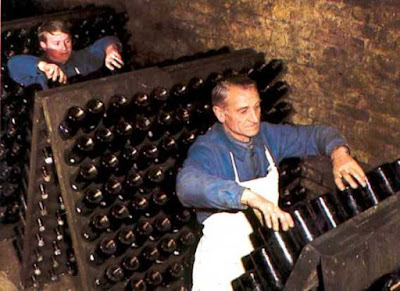

Riddlers painstakingly turn each bottle daily
Now that the yeasts have all floated to the neck of
the now positioned vertical bottle, they must be removed. This involves another hands-on process called
“disgorgement.” In short, the bottle is
kept in its vertical position (cork side down) and placed in ice just long
enough for the area near the cork to freeze.
With lightening-speed the cork is removed (and with the cork the frozen dead
yeasts adhering to the cork are also removed), and a new cork is placed….all at
the blink of an eye by a well-seasoned “disgorger.” But
the Champagne is not ready yet. It now
needs to “rest” for months or even years before it is sold.
 Dead yeasts accumulate in the vertically positioned bottle & are frozen before removed.
Another reason that Champagne is pricey is the notion
of supply and demand. The Champagne region
is the smallest wine region in France and produces a limited number of
bottles. Globally, Champagne accounts
for <1% of total wine production. To
further complicate the issue Champagne is France’s most northern wine
area. There are some years in which
grapes do not ripen adequately, thus further limiting availability and driving
up the cost.
In summary, the Champagne process is long and complex,
with many steps along the way that necessitate workers with well-honed special
skills. Production is limited. All of this translates to do-re-mi for the
consumer. Wine Knows will be visiting both the Champagne and Burgundy regions in June 2019. For more information about this trip visit www.WineKnowsTravel.com.


